Résultat
countries covered
Résultat
broker records extracted from official government registries
Résultat
priority scores on every record
● Context
The Problem: You Can't Sell Into a Market You Haven't Mapped
SantéVet is a French MGA (Managing General Agent) specializing in pet insurance. With an ambitious target: growing B2B revenue from 11% to 30% by 2028. Their go-to-market relies on insurance brokers across Europe who distribute SantéVet products to end clients.
The challenge was structural: SantéVet had no reliable, complete database of their target market. Their Salesforce CRM held fragmented data, some French brokers, scattered European contacts, but nothing a sales team could actually build a pipeline from.
And their target market is among the hardest to map in B2B: regulated insurance intermediaries across five European countries, each governed by its own national registry, with its own data format, licensing categories, and access methods. No commercial B2B data provider, not Apollo, not ZoomInfo, not Kaspr, covers this segment with the depth or accuracy SantéVet needed.
This is the core TAM problem for regulated industries: the market exists, it's well-defined, and it's publicly registered but it's not in any commercial database. Building it requires going directly to the source.
● The Cashmyrr solution
Why TAM Building Comes Before Any Outreach
Before any sequence gets enrolled, before any SDR sends a first email, sales needs to know who exists, where they are, and how to prioritize them. Without a structured TAM, teams either waste prospecting time on low-fit accounts or miss entire market segments they didn't know existed.
For SantéVet, operating across five European markets with three distinct outreach motions (high-volume automation, structured mid-market sequences, and high-touch enterprise sales), a clean and scored TAM wasn't a nice-to-have. It was the prerequisite for everything else.
This is also why TAM comes at a specific moment in the CRM optimization cycle: after data cleaning and enrichment infrastructure is in place, and before lead generation launches. A TAM built on top of a messy CRM creates more problems than it solves.
Scope: Three Segments Across Five Markets
We defined the TAM across three distinct commercial segments:
| Segment | Volume | Outreach Motion |
|---|---|---|
| Independent brokers | ~50,000 | Automated sequences (Lemlist) |
| Mid-market firms | ~500 | Structured multi-step outreach |
| Enterprise accounts | 100–150 | High-touch, account-based sales |
Target markets: France, Spain, Germany, Belgium, and Italy. Five countries, five regulatory bodies, five different data architectures.
The Data Source Strategy: Going Directly to Government Registries
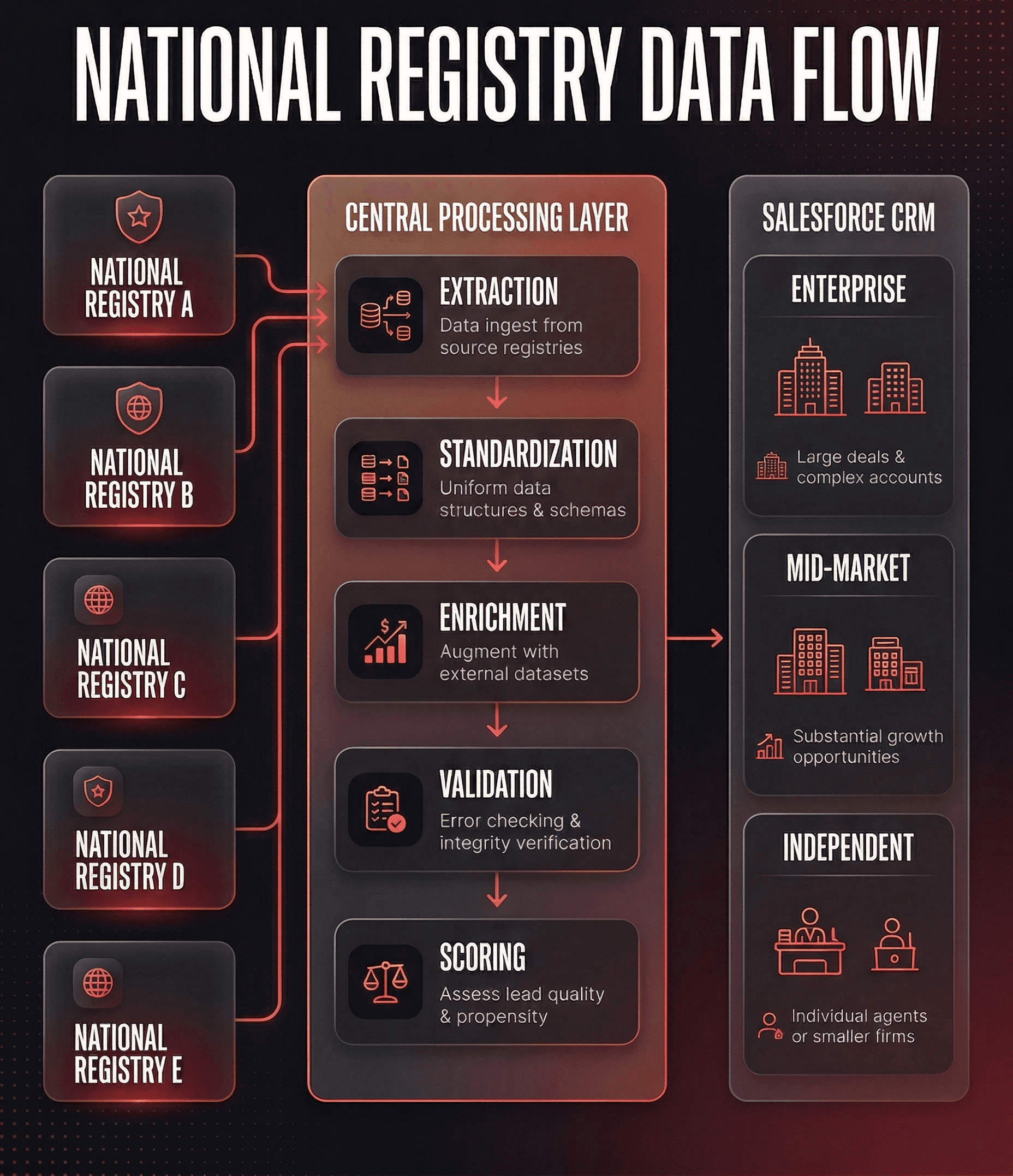
The foundation of the SantéVet TAM is official regulatory data. For each country, we identified the authoritative registry for licensed insurance intermediaries:
| Country | Registry | Body |
|---|---|---|
| 🇫🇷 France | ORIAS | Organisme pour le Registre unique des Intermédiaires en Assurance |
| 🇪🇸 Spain | DGSFP | Dirección General de Seguros y Fondos de Pensiones |
| 🇩🇪 Germany | BaFin / Vermittlerregisternummer | Bundesanstalt für Finanzdienstleistungsaufsicht |
| 🇧🇪 Belgium | FSMA | Financial Services and Markets Authority |
| 🇮🇹 Italy | IVASS | Istituto per la Vigilanza sulle Assicurazioni |
Each registry exposes different fields, uses different licensing category taxonomies, and provides data through different access methods, some via structured exports, others via paginated web interfaces. This is precisely why commercial data providers don't cover this segment accurately: the complexity of harmonizing five distinct regulatory systems isn't economically viable at scale for a horizontal B2B database.
For SantéVet, it was the only reliable path.
● Steps
The Full Pipeline
Step 1: Extraction
We wrote custom Python scripts for each national registry, handling the specific extraction logic for each data source: pagination, rate limiting, data format normalization, and error handling for incomplete records.
Output: five raw datasets with their native fields and structures.
Step 2: Standardization
Raw registry data is not CRM-ready. Company names are inconsistently formatted. Licensing categories use different naming conventions per country. Registration statuses are encoded differently.
We built a standardization layer that normalized all records into a unified schema: consistent company name format, mapped license categories across countries (e.g., "Courtier en assurance" in France, "Corredor de seguros" in Spain: same role, different label), validated registration statuses, and flagged inactive or suspended licenses before they ever reached the CRM.
Step 3: Enrichment
Registry data gives you the license. It doesn't give you a website, an email, a headcount, or any of the commercial context needed to qualify and prioritize an account.
We ran a multi-layer enrichment process:
- SERP queries to surface company websites and social profiles
- LLM-powered website parsing to extract business descriptions, specialties, team size signals, and contact information
- Industry validation booleans to confirm relevance to SantéVet's ICP (pet insurance distribution capacity, multi-line brokers vs. mono-product agents)
- Email extraction and validation for outreach readiness
- Review counts and digital footprint signals as proxy indicators of firm size and market presence
Step 4: Row-by-Row Validation
Bulk enrichment always produces edge cases: subsidiaries miscategorized as independent brokers, holding companies with multiple registered entities, inactive licenses that weren't flagged at the extraction stage, and industry classification errors at the margins.
We ran a record-by-record validation pass for high-priority accounts, specifically the enterprise and mid-market segments where qualification accuracy directly affects AE time. The long tail of ~50,000 independent brokers was validated through automated rules and sample checks.
Step 5: Scoring
Every record received a pre-calculated priority score from 1 to 100, built from a combination of:
- License type and scope (multi-line vs. mono-product)
- Firm size signals (team size, digital footprint, review counts)
- Geographic proximity to SantéVet's strongest distribution channels
- Estimated pet insurance distribution potential based on specialty focus
This means SantéVet's SDRs can sort any segment by score and start with the highest-priority accounts immediately, no manual triage required.
Step 6: CRM Import
Data was delivered in a Salesforce-ready structure with:
- Field mapping documentation for each object (Account, Contact)
- Deduplication logic matching against existing records by website URL and company name
- Segment tags for immediate routing to the correct outreach motion
- Pre-populated priority score field for sorting and filtering
The Validation Process
We didn't deliver everything at once. The process followed a staged validation model:
- Sample batch (200–300 records per country) delivered to SantéVet's team for quality review
- Feedback round: corrections on industry classifications, scope adjustments, edge case handling
- Larger batch delivered with corrections applied
- Final client sign-off before full delivery
This iterative approach matters because the client team understands their market better than any external data provider. A broker that looks valid from registry data might be a known non-starter in the market, the client team catches these in review.
● Result
What SantéVet Walked Away With
| Deliverable | Detail |
|---|---|
| Complete TAM | ~50K insurance brokers across France, Spain, Germany, Belgium, and Italy |
| Data source | Official government registries — not commercial databases |
| Segmentation | 3 tiers ready for activation (independent, mid-market, enterprise) |
| Enrichment | Websites, emails, industry validation, size signals, specialty flags |
| Scoring | Pre-calculated 1–100 priority score on every record |
| CRM delivery | Salesforce-ready with deduplication logic and field mapping |
| Methodology | Documented and replicable for additional European market expansion |
From TAM to Revenue: What Comes Next
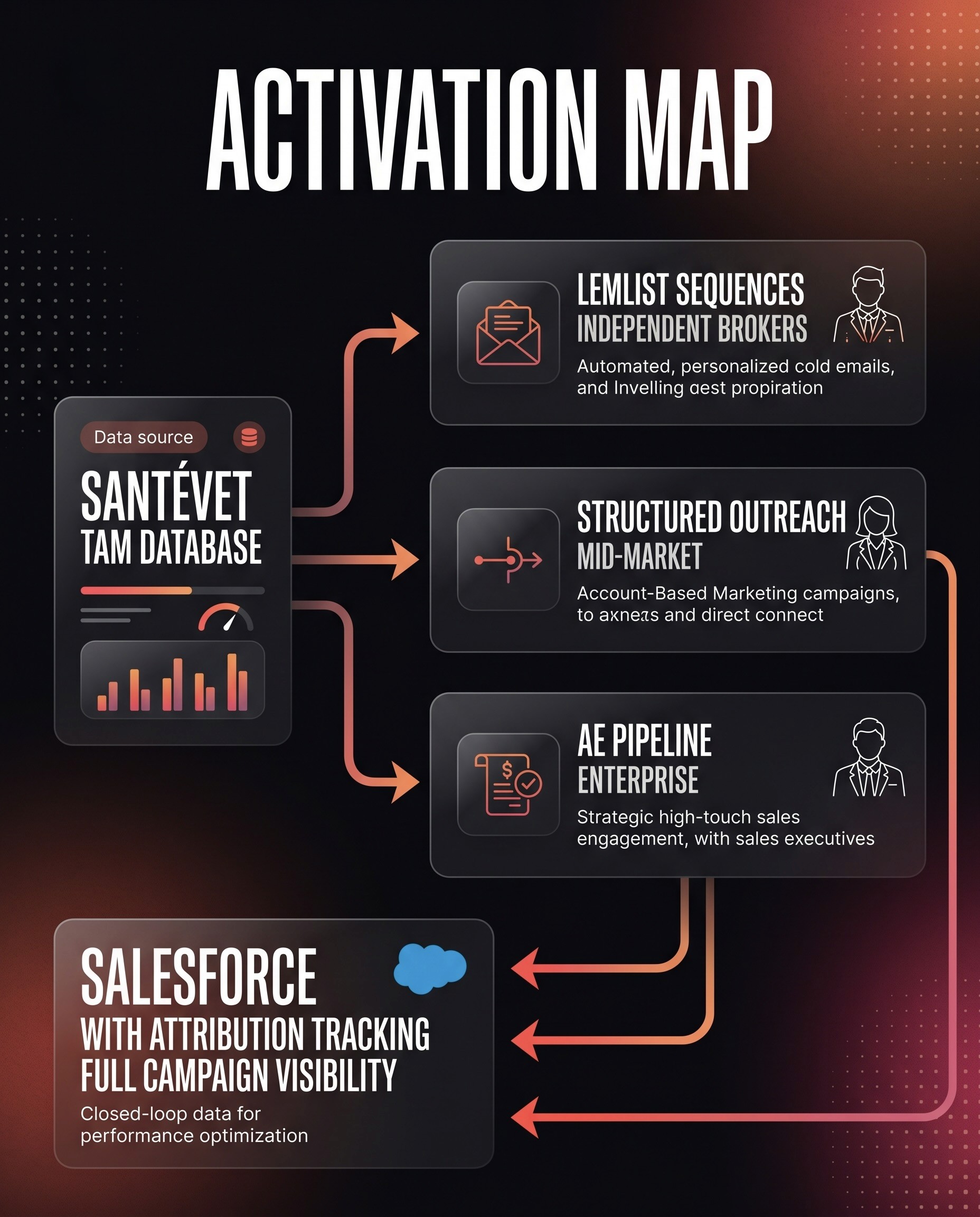
A TAM database is only valuable when it connects to an activated outreach motion. For SantéVet, the three-tier structure directly maps to three distinct go-to-market plays:
- ~50,000 independent brokers → enrolled in automated Lemlist sequences, low-touch, high-volume, optimized for deliverability at scale
- ~500 mid-market firms → structured multi-step outreach with personalization based on enrichment data (specialty focus, team size, geography)
- 100–150 enterprise accounts → high-touch ABM-style sales, each account individually researched, multiple stakeholders mapped, coordinated across AE and management
The scoring model ensures that within each tier, reps always start with the highest-priority accounts, not the first ones alphabetically.
SantéVet's roadmap also includes additional European countries. Because the methodology is documented: registry source, extraction logic, standardization schema, enrichment layer, scoring model, replication for a new market is an execution exercise, not a research project.
● FAQ
Commercial B2B databases are built for scale across horizontal segments (tech companies, professional services, SaaS). Regulated verticals, insurance intermediaries, financial advisors, healthcare, require license-level data that commercial providers don't capture accurately. Registration status, license type, and specialty focus are only reliably available from the official regulatory body. Any commercial database pulling from secondary sources will have significant gaps and outdated records in these segments.
For five countries at this scope (~51,000 records + enrichment), the full cycle from extraction to Salesforce-ready delivery takes 4–8 weeks depending on data quality at the source and the number of validation rounds required. Single-country TAMs can be delivered significantly faster.
A prospecting list is a flat export of contacts that match a rough filter. A TAM is a structured, scored, and segmented database that maps your entire addressable market, not just the slice that's easy to find. The distinction matters operationally: a TAM tells you how much of the market you've covered, which segments remain untouched, and where to allocate sales resources across the full pipeline horizon.
We build deduplication logic before import, matching new records against existing CRM data using a combination of website URL, company name (normalized), and registration number where available. Ambiguous matches are flagged for manual review rather than automatically merged because incorrect merges are harder to fix than unresolved duplicates.
Yes. The core approach, identifying the authoritative regulatory registry per market, extracting structured data, standardizing across jurisdictions, and enriching with commercial context, applies to any regulated industry with national licensing bodies. The effort varies based on registry accessibility and data quality per country.
● More case studies