● The context
Know what works. Stop funding what doesn't.
Marketing attribution is the practice of identifying which channels, campaigns, and touchpoints actually contribute to revenue and how much credit each one deserves. It answers the question every CMO gets asked: "Where did this deal come from?"
The problem is, in B2B, that question has never been simple. The average B2B buyer journey now lasts 272 days, involves 88 touchpoints, four channels, and ten stakeholders (Thunderbit, 2026 B2B Marketing Statistics). A prospect might discover you through a LinkedIn post, download a whitepaper three weeks later, attend a webinar two months after that, and only request a demo when a colleague forwards an email sequence. Which of these "created" the deal?
If your answer is "the last click", you're probably misallocating budget. If your answer is "we don't really know", you're not alone. Only 52% of senior marketing leaders say they can prove marketing's value and receive credit for it. And 38% of marketers say attribution is their #1 analytics challenge.
The gap isn't about tools. It's about the operational layer underneath: CRM properties, UTM discipline, lifecycle definitions, and reporting architecture. Attribution without that foundation is just a dashboard nobody trusts.
What you should get at the end (the deliverables):
- an Attribution Model Decision (which model(s), and why they fit your business)
- a Tracking Architecture (UTMs, properties, campaign structure, cookie/consent setup)
- a Reporting Framework (dashboards per team: marketing, sales, leadership)
- a Governance Playbook (naming conventions, tagging rules, who maintains what)
If those aren't clearly produced, attribution becomes a political tool, not a strategic one.
● The stages
1. Why attribution matters (the cost of getting it wrong)
Without attribution, marketing becomes a faith-based exercise. You spend, you hope, and you argue in quarterly reviews about which campaign "really" worked.
The numbers tell a clearer story:
- Companies that switch from single-touch to multi-touch attribution see an average 22% increase in budget efficiency.
- 74% of high-growth companies use multi-touch attribution vs. the majority of slower-growing peers still stuck on last-click.
- Attribution-driven companies scale winning campaigns 2.1x faster and can reduce CAC by 8–24% depending on maturity.
- B2B sales cycles average 92 days from first touch to closed deal, and 71% of B2B buyers consume 4+ pieces of content before contacting sales.
The practical consequence: if you only credit the last touchpoint, you systematically underfund the awareness and nurture activities that actually fill the top of the funnel. Over time, pipeline dries up and nobody understands why, because the "conversion" channels that got all the credit didn't actually create the demand.
Attribution isn't a reporting feature. It's a budget allocation system. Get it wrong, and every downstream decision, hiring, channel mix, campaign design, inherits the error.
2. What attribution is (and what it is not)
The simplest definition
Marketing attribution answers three questions:
- Which channels and campaigns influenced a deal? (the touchpoint map)
- How much credit does each touchpoint deserve? (the model)
- What should we do differently next quarter? (the budget decision)
It's not lead scoring (which prioritizes who to contact). It's not pipeline reporting (which tracks where deals sit). Attribution is the bridge between marketing spend and revenue outcome, the "why did this deal happen?" layer.
What it is not
Attribution is not:
- "Let's buy a $50K platform and expect answers to appear."
- "Let's tag everything with UTMs and figure it out later."
- "Let's give 100% credit to the last click and call it a day."
- "Let's build a model so complex that nobody believes it."
Those are the fastest ways to turn attribution into organizational noise instead of signal.
The fundamental tension
Every attribution model is a simplification. The real buyer journey is messy, non-linear, and involves multiple people at the same account. No model captures all of that perfectly. The goal is not perfection, it's decision-grade insight: accurate enough to inform budget allocation and campaign strategy, transparent enough that marketing and sales don't argue about the numbers.
3. The attribution models (and when to use each)
There's no single "best" model. Each one answers a different strategic question. The key is to understand what question you're trying to answer, then pick the model that fits.
Single-touch models
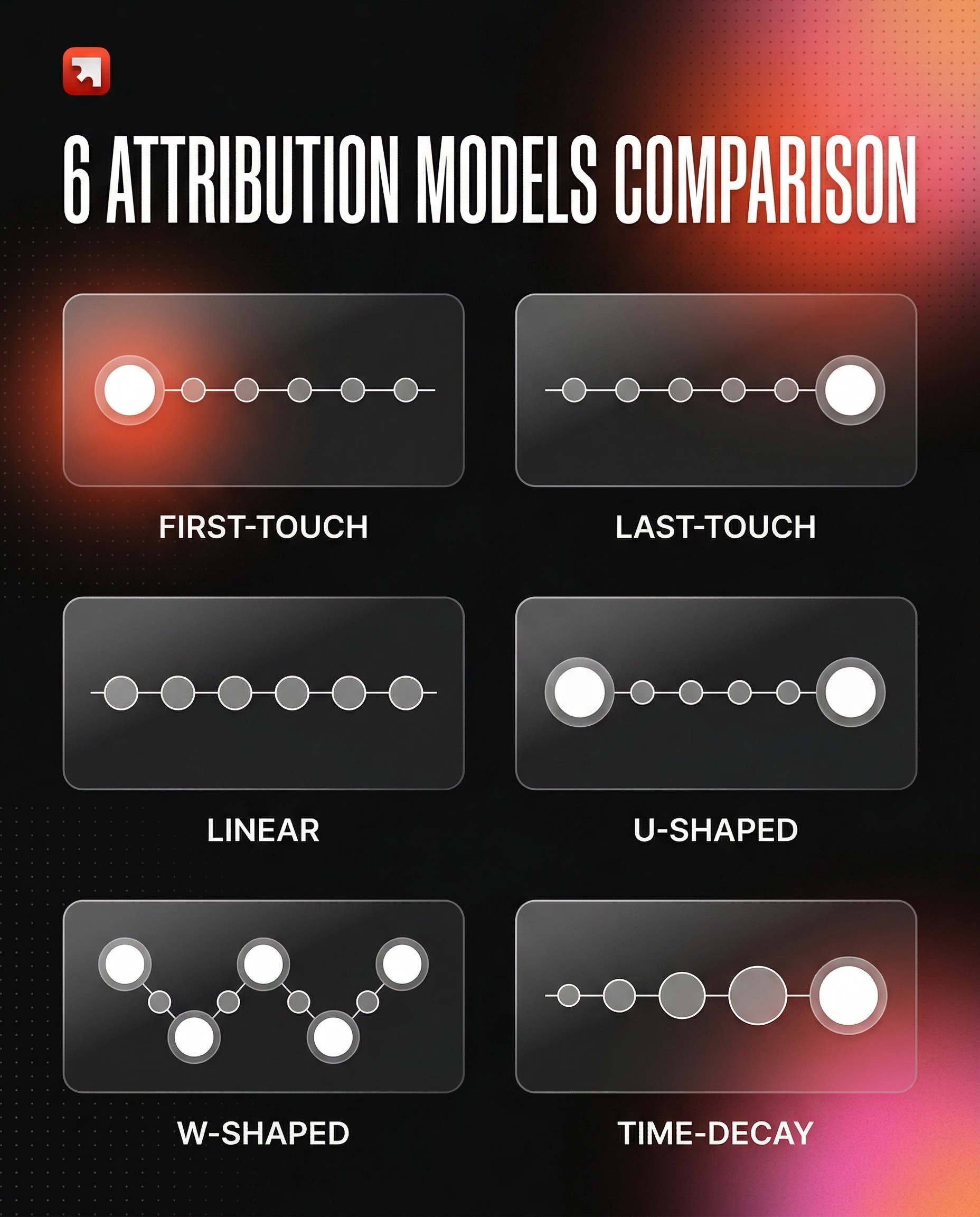
First-touch attribution gives 100% credit to the first interaction a contact had with your brand. It answers: what generates demand?
Best for: understanding which channels fill the top of the funnel. If you're trying to decide between investing in SEO, paid social, or events for awareness, first-touch shows you where people first discover you.
Limitation: completely ignores everything that happens after. A prospect who first clicked a Google ad but converted because of a 6-month nurture sequence? Google gets all the credit.
Last-touch attribution gives 100% credit to the final interaction before conversion. It answers: what closes deals?
Best for: understanding what pushes prospects over the line: demo requests, bottom-of-funnel content, sales outreach.
Limitation: hides the entire journey that built enough trust for that final conversion.
Despite their flaws, nearly 90% of B2B marketing teams still rely on single-touch or basic multi-touch models. That's a major gap.
Multi-touch models
Linear attribution splits credit evenly across all touchpoints. It answers: what does the whole journey look like?
Best for: getting a neutral, balanced view when you don't want to bias toward any stage. Good starting point for teams new to multi-touch.
Limitation: treats a casual blog visit the same as a demo. Not all touches are equal.
U-shaped attribution gives the most credit (~40% each) to the first touch and the lead creation moment, distributing the remaining ~20% across middle touches. It answers: what generates awareness AND what converts leads?
Best for: B2B demand generation teams who care about both acquisition and conversion.
W-shaped attribution adds a third weighted moment, the opportunity creation, on top of the U-shape. First touch, lead creation, and deal creation each get ~30%, with ~10% distributed across everything else. It answers: what drives the full marketing-to-pipeline journey?
Best for: B2B SaaS with clear milestone stages (MQL → SQL → Opportunity).
Time-decay attribution gives more credit to interactions closer to conversion. It answers: what accelerated the deal?
Best for: shorter sales cycles or teams focused on optimizing the bottom of the funnel.
Full-path attribution extends the W-shape by also crediting the closed-won moment. It answers: what touches mattered at every critical stage?
Best for: companies with long cycles and sales-marketing alignment mature enough to track all four milestones.
Our recommendation: start with two, not one
Run two models in parallel: U-shaped (or W-shaped) as your primary operational model, and first-touch as a secondary lens for demand-gen analysis. Comparing them reveals where your funnel creates value vs. where it captures value. That tension is where the best budget decisions live.
4. The tracking architecture (the part people skip)
Attribution models are only as good as the data feeding them. If tracking is broken, no model will save you. This is where most attribution projects quietly fail, not in the model selection, but in the plumbing.
UTM standardization: the foundation
UTM parameters (source, medium, campaign, term, content) are how you tell the CRM where a touchpoint came from. Without standardized UTMs, your attribution data becomes a mess of inconsistent values that can't be grouped or compared.
Rules we enforce:
- Lowercase everything.
LinkedInandlinkedinare two different sources in most CRMs. - Use a shared taxonomy. Define allowed values for
utm_source(google, linkedin, facebook, email, direct, referral, event…) andutm_medium(cpc, organic, social, email, webinar, display…). Document them. Enforce them. - Never free-text
utm_campaign. Use a naming convention:[year]-[quarter]-[channel]-[campaign-name]. Example:2026-q1-linkedin-revops-guide. - Tag everything. Every email, every ad, every social post, every event registration link. If it's not tagged, it doesn't exist in attribution.
Cookie and consent setup
Attribution starts with anonymous visitor tracking. If your cookie consent implementation blocks tracking scripts before consent, you lose the first part of the journey for most visitors.
This is a real tension: privacy compliance vs. attribution accuracy. The practical approach:
- Implement a consent management platform that fires tracking cookies only after explicit consent (GDPR-compliant).
- Accept that you'll lose some anonymous-to-known connections. Plan for it by also using self-reported attribution ("How did you hear about us?") as a complementary signal.
- Use first-party cookies, not third-party. Third-party cookie deprecation is reshaping the landscape, 78% of existing attribution setups will be impacted (Marketing LTB).
Campaign structure in the CRM
Every marketing initiative, ad campaign, webinar, email sequence, event, content download, should be represented as a Campaign in the CRM (HubSpot or Salesforce). This is the object that bridges "marketing did something" and "a deal was influenced."
Without campaigns properly set up and assets tagged to them, the CRM can't link touchpoints to revenue. It's the single most common gap we see in CRM audits.
5. How to implement attribution in HubSpot
HubSpot's attribution reporting has matured significantly. Here's how to set it up for real.
What HubSpot tracks natively
HubSpot's attribution engine automatically records interactions including: page views, form submissions, marketing email clicks, CTA clicks, ad clicks from tracking URLs, chat interactions, meeting bookings, and workflow-triggered events.
Important: as of 2026, email opens are excluded from attribution credit due to privacy-shielded data (Apple Mail Privacy Protection). Plan around clicks, not opens.
The three types of attribution reports
HubSpot offers three attribution report types, each measuring a different conversion milestone:
- Contact create attribution: which marketing efforts generate the most new contacts. Think of this as top-of-funnel measurement.
- Deal create attribution: which efforts result in the most new deals. This is your mid-funnel view. (Marketing Hub Enterprise only.)
- Revenue attribution: which efforts drive the most closed-won revenue. This is the bottom line. (Marketing Hub Enterprise only.)
Building all three gives you a full-funnel view of marketing impact.
Available models in HubSpot
HubSpot provides: First interaction, Last interaction, Linear, U-shaped, W-shaped, Time decay, J-shaped, Inverse J-shaped, and Full path.
For most B2B teams, we recommend starting with W-shaped (for pipeline-focused reporting) and running First interaction alongside it (for demand-gen analysis).
Setup steps
- Standardize your campaigns. Go to
Marketing > Campaigns. Create a campaign for every meaningful initiative. Tag all associated assets (emails, landing pages, forms, CTAs, ads) to the right campaign. - Enforce UTM discipline. Use HubSpot's tracking URL builder to generate consistent UTMs. Set up a shared naming convention document that the team follows.
- Build attribution reports. Navigate to
Reporting > Reports > Create Report > Attribution. Select the report type (Contact create, Deal create, or Revenue), choose your model(s), and filter by date range, pipeline, or lifecycle stage. - Add to team dashboards. Create separate dashboards per audience:
Custom properties for deeper tracking
Beyond native reports, we build custom properties on the Contact object to capture attribution data that HubSpot's native tracking doesn't always preserve cleanly:
First Touch Attribution Source(Dropdown): the original channelLast Touch Attribution Source(Dropdown): the conversion triggerAttribution Journey(Multi-line text): a log of key touchpointsLead Source Detail(Single-line text): the specific asset or campaign
These are especially useful when integrating outbound activities (sequences, SDR touches) that don't always flow through HubSpot's campaign tracking.
Key limitation to know
HubSpot's native revenue attribution requires Marketing Hub Enterprise. On Professional, you can build contact create attribution but won't get deal or revenue-level attribution natively. For Professional-tier teams, workarounds include building custom reports with cross-object filters (Contact → Deal) or using third-party attribution tools that sync into HubSpot.
6. How to implement attribution in Salesforce
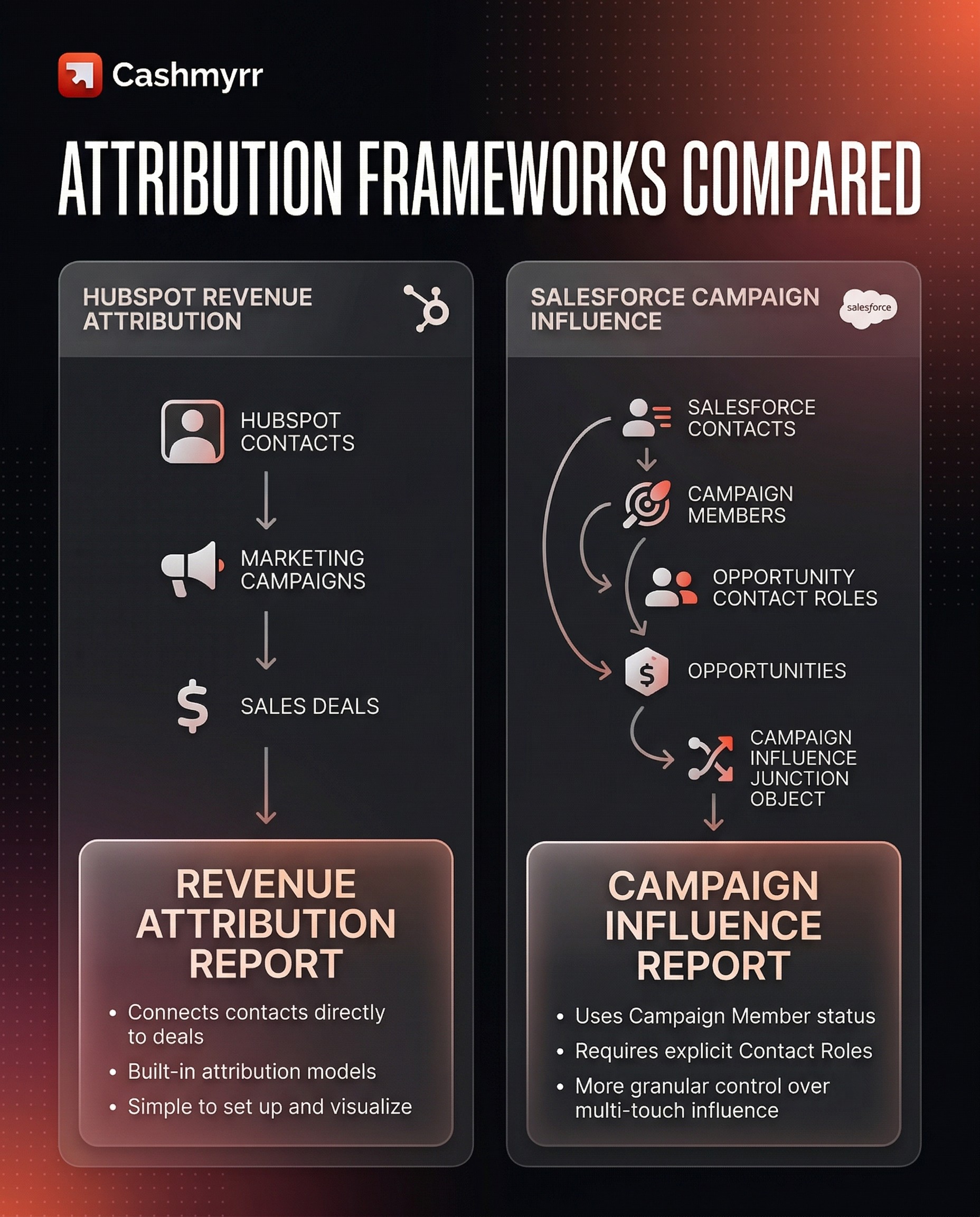
Salesforce handles attribution differently through Campaign Influence, a feature that links campaigns to opportunities via contact roles.
The two flavors of Campaign Influence
Primary Campaign Source (the default): assigns 100% credit to a single campaign per opportunity. Simple, but limited. This is what most Salesforce orgs use out of the box and it's effectively last-touch with manual override.
Customizable Campaign Influence: the multi-touch version. It creates a junction object (CampaignInfluence) that links multiple campaigns to each opportunity, with percentage influence and revenue share. This is where real attribution lives in Salesforce.
Available models (with Pardot/Account Engagement)
When you enable Additional Campaign Influence Models (requires Pardot or Performance/Unlimited Edition):
- First-touch: 100% credit to the first campaign a contact engaged with (based on Campaign Member created date).
- Last-touch: 100% credit to the last campaign before deal close (based on Campaign Member last modified date).
- Even distribution: equal credit across all campaigns a contact interacted with.
- Custom models: you define the weightings, either manually or via Apex/Flow.
Setup steps
- Enable Campaign Influence. Navigate to
Setup > Campaign Influence Settings. Enable Customizable Campaign Influence. Click Edit again and enable Additional Campaign Influence Models. - Configure auto-association. Set the time frame (e.g., 90 days) that determines how far back a campaign member interaction counts as influential for an opportunity.
- Ensure Contact Roles are populated. This is critical: Campaign Influence works through the Contact Role → Opportunity link. If your reps don't add contact roles to opportunities, the attribution chain breaks. Automate this where possible using Flow Builder.
- Add related lists. Add the "Influenced Opportunities" related list to Campaign page layouts and the "Campaign Influence" related list to Opportunity page layouts.
- Build reports. Use the "Campaigns with Influenced Opportunities" report type. Filter by model, date range, and campaign type.
Custom implementation for advanced attribution
For teams that need more than the standard three models, Salesforce supports custom models via Apex triggers or Flow. Common use cases:
- Time-weighted model: campaigns before opportunity creation get higher weight than post-creation campaigns.
- Campaign-type-weighted model: events and demos get more credit than email clicks.
- Account-level attribution: roll up all contact-level campaign influence to the account level for ABM reporting.
Key limitation to know
Salesforce Campaign Influence only starts tracking from the moment a lead/contact is created in the CRM. Anonymous website visits before lead creation are invisible unless you integrate a third-party tool (like Ruler, Bizible, or a custom first-party tracking implementation). This is a significant blind spot for top-of-funnel attribution and it's the same gap that the RevSure report highlights: nearly 90% of B2B teams either ignore or fail to unify anonymous interactions.
7. Self-reported attribution: the missing layer
Models track clicks and sessions. But B2B buying behavior increasingly happens in places that can't be tracked: podcasts, dark social (private Slack groups, WhatsApp), word-of-mouth, conference conversations, community forums.
That's why the best attribution systems layer in self-reported attribution: a simple question on your demo request or high-intent form asking "How did you first hear about us?"
This field should be:
- Open text, not a dropdown (let people tell you in their words)
- Placed on high-intent forms only (not every blog subscription)
- Stored in a dedicated CRM property (
Self_Reported_Source) - Reviewed manually on a monthly cadence to spot patterns
Self-reported attribution doesn't replace model-based attribution. It complements it. The model tells you what people clicked. The self-reported field tells you what influenced them. The best budget decisions come from triangulating both.
8. The governance layer (keeping attribution clean over time)
Attribution decays. UTMs drift. New team members tag campaigns differently. Integrations break tracking. Without ongoing governance, your attribution data has a shelf life of about 3–6 months before it becomes unreliable.
Naming conventions
Document and enforce a shared taxonomy for:
- UTM sources and mediums (a finite list, not free text)
- Campaign names (structured:
[year]-[quarter]-[type]-[name]) - Lifecycle stage definitions (when does a contact become an MQL? Who decides?)
Monthly hygiene checks
- % of deals with attribution data filled vs. missing
- % of contacts with
utm_sourcevs.(direct) / (none) - Top 10 campaign names — are they consistent, or is there drift?
- Self-reported vs. model-based: are they telling the same story?
Quarterly attribution review
Once per quarter, sit down with marketing, sales, and RevOps to review:
- Which channels drive the most pipeline per dollar?
- Where does model-based attribution disagree with self-reported?
- Are there campaigns getting credit they don't deserve (or vice versa)?
- What budget reallocation does the data suggest?
This is the meeting where attribution actually becomes a strategic tool, not just a dashboard.
● The results
What "good" looks like after attribution is in place
After a well-implemented attribution system:
- Marketing can prove its contribution to revenue: not just leads, but actual closed-won deals, broken down by channel, campaign, and content asset.
- Budget conversations are evidence-based, not political. You can show that LinkedIn generates 3x more pipeline per dollar than display ads, or that webinars influence 23% of mid-funnel progression.
- Sales and marketing share a common language. Both teams see the same data. "Where did this deal come from?" has a documented, multi-touch answer, not a finger-pointing session.
- Leadership gets a reliable ROI view. One dashboard showing revenue by channel, cost per acquisition, and attribution model comparison, not a spreadsheet someone assembled manually the night before the board meeting.
- A governance rhythm is running, so the data doesn't decay: UTMs stay clean, campaigns stay tagged, and someone reviews the attribution health monthly.
You're not "tracking campaigns." You're building the decision system that tells you where to invest your next dollar.
