● The context
The Problem Every Sales Team Knows Too Well
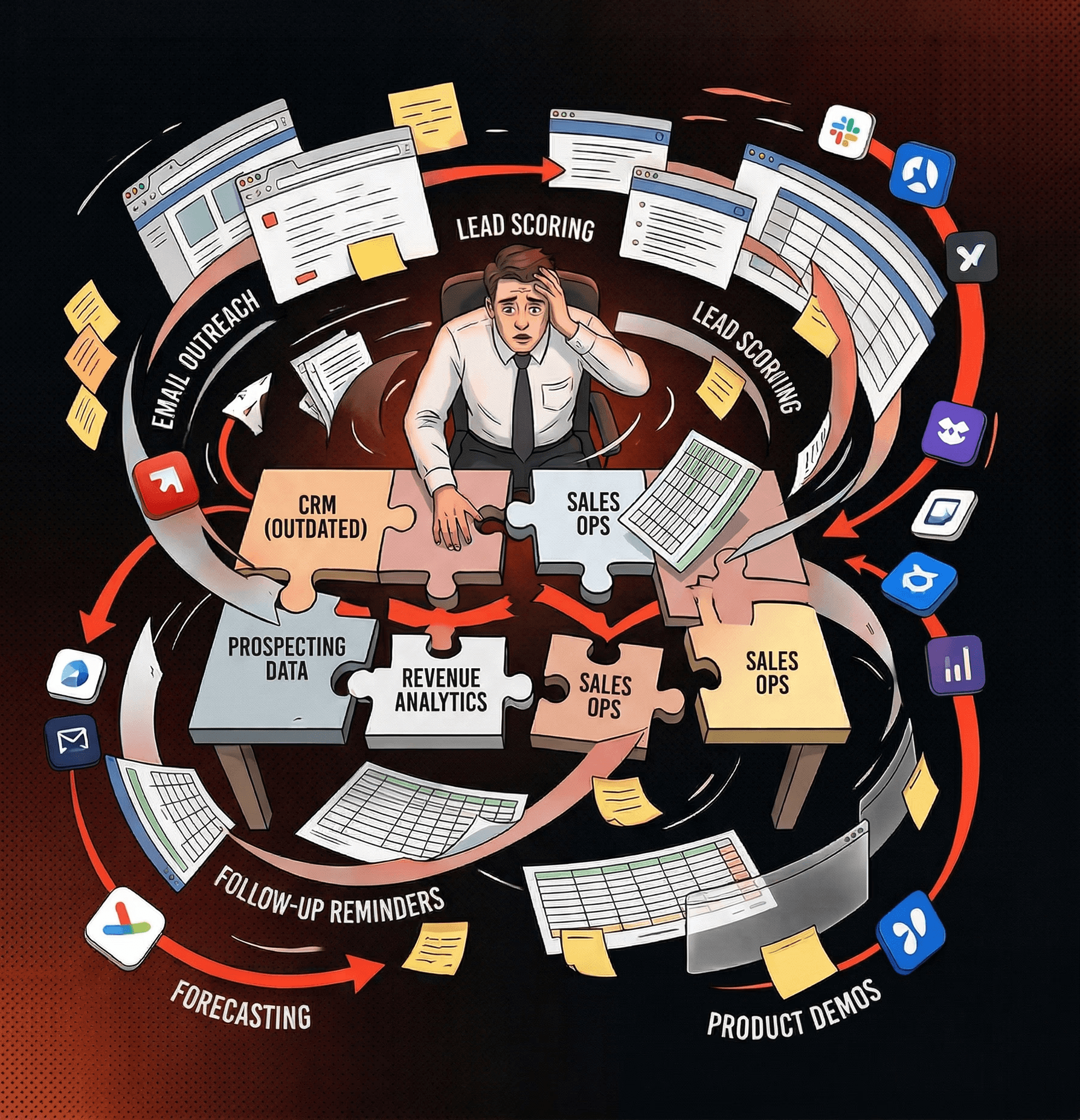
Sales is a people business but somewhere along the way, salespeople started spending most of their day fighting their CRM instead of talking to customers.
Finding the right contact, remembering who said what, preparing for a call, drafting a follow-up email, researching a prospect's funding history, filling in missing contact data, each of these tasks takes minutes. Multiply that by dozens of interactions a day, and you lose hours every week to administrative work that should take seconds.
But the time drain is only half the problem. The deeper issue is trust.
Salesforce reports that only 35% of sales professionals completely trust the accuracy of their CRM data. When teams don't trust the data, they stop using the CRM consistently. When adoption drops, data quality gets worse. And when data quality gets worse, every dashboard, every automation, and every AI tool built on top of it becomes unreliable. Gartner research puts the average cost of poor data quality at $12.9 million per year for organizations.
Most companies try to fix this with more tools. A LinkedIn scraper. An email finder. A CRM enrichment service. A prospecting database. A call prep assistant. Each one is another tab, another login, another subscription and none of them talk to each other. Generic AI tools write generic emails. Disconnected tools create disconnected workflows.
That's exactly the problem Cashmyrr built Sales AI Agent to solve.
What Is Sales AI Agent?
Sales AI Agent is an AI-powered sales assistant that connects directly to your HubSpot CRM and acts as a single, intelligent workspace for your entire sales workflow.
Instead of navigating menus, running searches, copying data between tabs, and paying for five separate tools, your sales team simply has a conversation.
Ask it who your top contacts are at a company. Ask it to write a personalized follow-up email in your tone. Ask it what's happening with a specific deal. Ask it to find similar companies you've already won. Ask it what funding rounds your prospect just closed. Get the answer in seconds, in plain language.
Think of it as a deeply knowledgeable colleague who has memorized your entire CRM, knows your products inside out, researches your prospects automatically, and is available 24/7.
But here's what makes it fundamentally different from other AI sales tools: it doesn't work on top of broken data. It works at the end of a proven RevOps chain and that chain is what makes the intelligence real.
Why Most AI Sales Tools Fail (And Why This One Doesn't)
The dirty secret of AI in sales is that the model is rarely the bottleneck. The data is.
Layer a chatbot on top of a CRM full of duplicates, empty fields, outdated contacts, and inconsistent deal stages, and you get confident-sounding answers built on garbage. The AI doesn't know the data is wrong, it just reads what's there and responds as if it's truth.
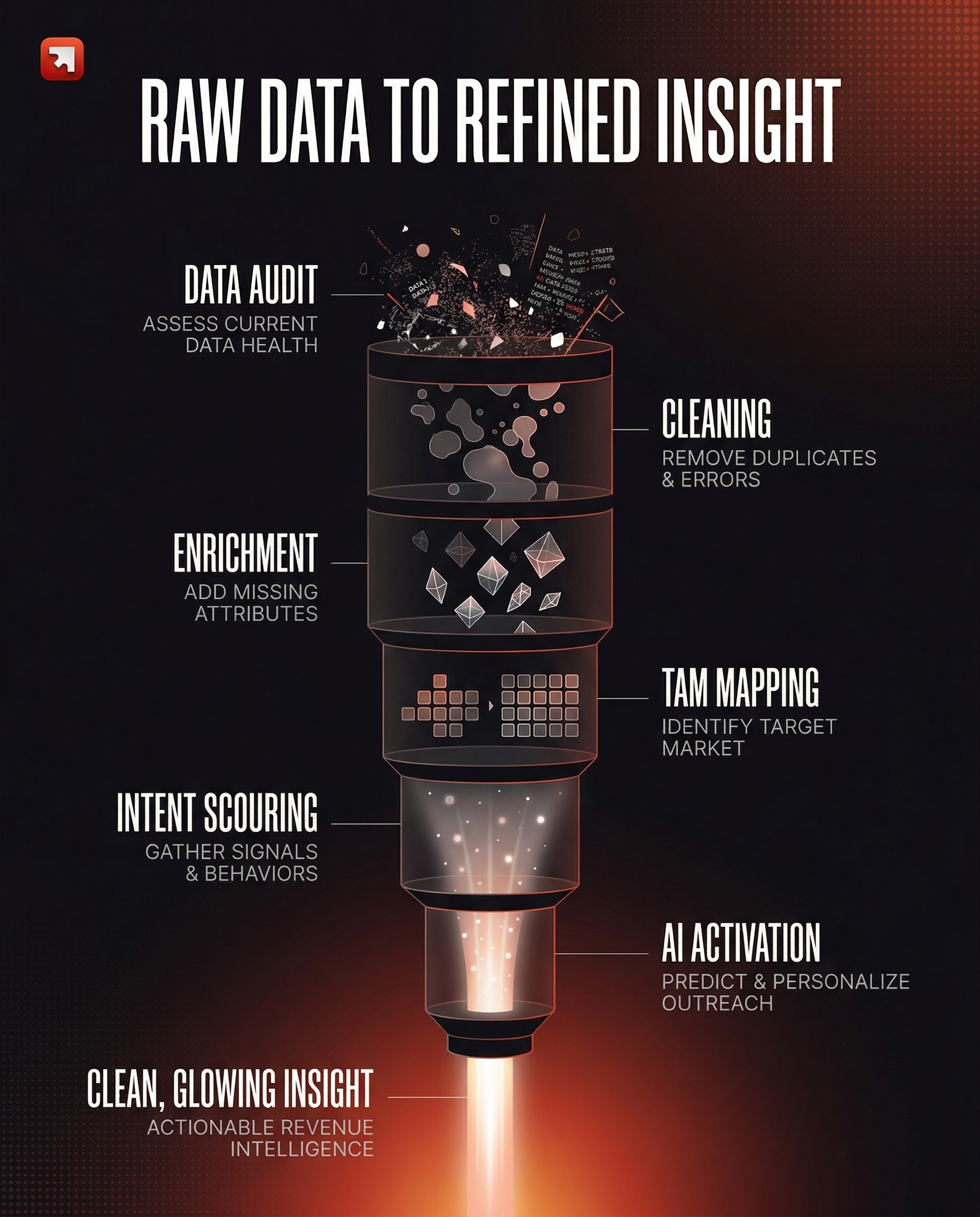
That's why Sales AI Agent was designed to sit at the end of a complete CRM optimization process, not as a band-aid on top of a broken one. The sequence matters: Audit → Data Cleaning → Enrichment → TAM Integration → Intent Signals → AI Activation.
Each step builds the foundation the next one depends on.
Without an audit, you don't know what's broken. The CRM might have overlapping fields, workflows that contradict each other, lifecycle definitions that nobody agreed on, or integrations that write unexpected data into unexpected places. An audit compares what the business intends to achieve with what teams actually do, and evaluates how the CRM behaves in practice. It produces a prioritized action plan that fixes root causes, not symptoms.
Without data cleaning, the AI reads noise. Duplicates inflate counts and break workflows. Free-text fields create ten different spellings of the same industry. Close dates are unreliable. Deal stages don't reflect reality. Data cleaning isn't about making everything perfect, it's about reaching decision-grade quality on the fields that actually drive revenue, reporting, and handoffs.
Without enrichment, the AI lacks context. A company record with no industry, no headcount, no website is useless for segmentation or personalization. A contact with no email, no LinkedIn, no job title can't be reached. Enrichment fills the exact gaps that block the next action, scoring, routing, outreach, without dumping data everywhere.
Without TAM integration, the AI can't prioritize. If you haven't defined which companies are in your Total Addressable Market, scored them, and tiered them, the AI treats every account the same. The difference between a Tier 1 account that matches your ICP perfectly and a Tier 3 account that barely qualifies should change everything: the speed of follow-up, the seniority of the rep assigned, the depth of research. TAM integration makes that distinction operational.
Without intent signals, the AI can't tell you when to act. Knowing that a company fits your ICP is useful. Knowing that same company just raised a Series B, posted a job for a CRM Manager, and visited your pricing page three times this week, that's urgent. Intent data captures behavior happening outside your ecosystem: third-party research, competitor comparisons, funding announcements, hiring patterns. It tells you what accounts are doing when they don't know you're watching.
Sales AI Agent inherits all of this. When a rep opens a conversation, the AI isn't guessing. It's reading from a CRM that has been audited, cleaned, enriched, segmented, and connected to live market signals. That's not a chatbot. That's an intelligence layer.
● The stages
A Full Briefing Before Every Conversation
When a sales rep opens Sales AI Agent and starts working on a prospect, the AI doesn't start from zero. It walks in fully briefed.
Before each conversation, the agent automatically loads everything relevant from HubSpot:
- the full company profile (industry, size, revenue, domain, description),
- every contact associated with the account with their titles and roles, all open and past deals with their stages and values,
- the last 100 activities going back two years (emails sent, calls logged, meetings scheduled, notes written),
- a memory summary of everything discussed in previous conversations with that account
- the assigned sales rep for that account
This isn't just data retrieval. It's a complete briefing. Ask "where are we with this account?" and the AI actually knows, because it just read the entire relationship history before responding.
The quality of that briefing depends entirely on what's in the CRM. If the audit, cleaning, and enrichment were done right, the briefing is decision-grade. If they weren't, it's noise dressed up as insight. The foundation is the product.
A Dashboard Built Around Your Business
Most AI tools are generic. Sales AI Agent is configured around your company, your products, and your way of selling.
Your company profile, mission, positioning, differentiators, becomes the foundation of how the AI represents you. Your product catalog, with names, descriptions, and key features for each offering, is what the AI draws from when drafting a pitch or an email. It knows what you sell and how to talk about it without you explaining it every time.
Your email writing guidelines define the tone, the style, what to avoid, how to open, how to close. Every email the AI generates follows these rules. Every rep sounds consistent, professional, and on-brand, automatically.
And then there are presets: reusable conversation starters tailored to your team's most common tasks. Create one called "Cold Call Opener" and the AI instantly crafts a 30-second opening script based on the live prospect profile. Create "Account Overview" and it summarizes the entire relationship in one message. Any team member activates a preset with a single click. No prompt engineering required. Your best practices, shared with everyone.
Smart Company Recommendations: AI That Finds Your Best References
One of Sales AI Agent's most unique capabilities is its ability to find companies in your own CRM that look like the prospect you're working on. This is where TAM integration pays off directly.
Here's what happens behind the scenes :
- The agent reads the website of every company in your HubSpot.
- It uses AI to generate a structured summary: what industry they're in, what they sell, who they sell to, how their business works.
- It converts each summary into a mathematical fingerprint that captures the essence of that company.
- When you're preparing to work on a prospect, it compares fingerprints across your entire database
- It surfaces the most similar companies you've already closed deals with.
The result is a curated list of relevant references and case studies — not random, but mathematically matched. Companies in the same space, at a similar stage, with similar challenges.
For a sales rep, this is a game-changer. "Here are three companies just like yours that we already work with, and here's what we helped them achieve." Credibility, instantly.
This only works because the CRM data underneath is clean and enriched. If company records are missing industries, descriptions, or domains, the fingerprinting has nothing to work with. If duplicates exist, the same company shows up twice with conflicting data. The recommendation engine is powerful but it's only as good as the data it reads.
Fundraising Intelligence: Automated Research in Seconds
Prospecting a startup or growth-stage company? Sales AI Agent automatically finds their entire funding history.
The agent searches across news articles, press releases, and investment databases and extracts:
- every funding round (Seed, Series A, B, C and beyond)
- the amounts raised
- the investors and VC firms involved
- the dates of each round
- a brief description of what the round was for.
It even searches in the local language of the company. French startup? It searches in French. German company? German. Spanish? Spanish. The results are structured, cleaned, and presented clearly, no manual research required.
This data is refreshed automatically every 30 days, so you're always working with current intelligence.
This is intent data in action. A company that just raised a Series B is telling you something: they have budget, ambitions, and urgency. Post-funding, most companies restructure their go-to-market stack within 90 days. Fresh capital means new tools, new hires, and new infrastructure decisions. The window is short, but the budgets are real. That's not a cold call, that's arriving at the right moment with the right context.
Built-In Contact Enrichment
Your CRM is only as good as the data in it and most CRMs are full of gaps. Missing emails. No LinkedIn profiles. Incomplete phone numbers.
Sales AI Agent starts solving this directly inside the workflow. When you work on a contact, the platform can enrich their profile with key data points, most notably their LinkedIn profile URL, along with available contact information like email addresses and phone numbers. The real advantage here is simple but meaningful: you never have to leave the agent to go hunt down a contact's LinkedIn. It's already there, ready to inform your next move.
This matters more than it sounds. Every time a rep tabs out to search for a LinkedIn profile, they lose momentum. They context-switch. They get distracted. By keeping that data inside the agent, the workflow stays unbroken and the enriched data flows back into HubSpot automatically, no manual entry, no copy-pasting between tools.
Now, here's where it gets exciting. The architecture behind this enrichment is already very close to doing much more. The natural next step — and one that's well within reach — is pulling in a contact's full professional history: every company they've worked at, their titles, the dates. That's when enrichment turns into activation. Imagine the agent cross-referencing a contact's past employers against your HubSpot deals, and surfacing that a prospect used to work at three companies that are already your customers.
That's an immediate, credible opening: "I noticed you used to be at Company X — they're actually a customer of ours."
This is the enrichment-to-activation loop that separates useful data from data hoarding. And Sales AI Agent is already laying the foundation for it — starting with the data that matters most in day-to-day prospecting, and building toward a system where every enriched field directly feeds a smarter sales conversation.
Full customization is available across all features
At the core of the experience sits a dedicated dashboard designed to give the agent all the context it needs to perform. From there, users can brief the agent on their company background and the individual sales rep's profile, define a custom tone of voice for every email it drafts, and provide detailed descriptions of every product and service in the catalog.
The result is an agent that genuinely understands who it works for and who it's talking to, building a granular awareness of its environment that generic tools simply can't match.
Beyond that, users can create custom presets: pre-written, reusable prompts tailored to recurring tasks. Instead of starting from scratch each time, reps trigger a preset and let the agent handle the rest, saving even more time on the workflows that fill up their week. A few examples:
- Pre-meeting briefing: get a full snapshot of the prospect, past interactions, and talking points before walking into a call.
- Contextual follow-up email: generate a relevant, personalized follow-up based on the latest exchange.
- Account strategy & action plan: outline a structured approach for progressing a deal, with concrete next steps.
Every layer of the agent can be shaped to match a team's language, process, and selling style — so it doesn't just automate tasks, it automates their tasks.
Intelligence That Stays Fresh
CRM data decays. People change jobs. Companies pivot. Funding rounds close. New competitors emerge. If you enrich once and never refresh, your database has a shelf life of about 8 to 12 weeks before accuracy starts dropping noticeably.
Sales AI Agent is designed around this reality. Fundraising intelligence refreshes automatically every 30 days. Contact enrichment runs every time a rep works on an account, catching job changes, new emails, and updated titles in real time. Company fingerprints update as businesses evolve, so recommendations stay relevant rather than stale.
This isn't a one-time data dump. It's a living system. The AI gets smarter over time because the data underneath it keeps improving, not because someone remembered to run a manual refresh, but because the refresh is built into the workflow itself.
For teams that have invested in building a proper data foundation, audit, cleaning, enrichment, TAM segmentation, Sales AI Agent protects that investment. It doesn't let the CRM drift back into the state it was in before. Every interaction with the tool is also a data quality check: enrichment fills gaps, activity logging keeps records current, and the AI flags inconsistencies that a human might miss.
● The results
The All-in-One Advantage
Most sales tools solve one problem. A LinkedIn scraper. An email writer. A CRM enrichment service. A prospecting database. A call prep tool. Each one is another tab, another login, another tool to learn, another monthly subscription.
Most sales tools solve one problem at a time. Sales AI Agent puts everything in one place:
| What you need | How Sales AI Agent covers it |
|---|---|
| Know your prospect before a call | Full CRM briefing, auto-loaded |
| Write a great follow-up email | AI drafting with your tone, style, and product catalog |
| Find relevant references | Smart similarity matching across your CRM |
| Research their funding history | Automated fundraising scraping, multilingual |
| Fill CRM data gaps | Built-in contact enrichment |
| Surface past relationship context | Conversation memory summaries |
| Scale best practices across the team | Presets shared at the organization level |
With Sales AI Agent, the entire workflow lives in one conversation. The funding signal, the contact data, the reference companies, the email draft, and the CRM update all happen in the same place. Nothing falls through the cracks because there are no cracks.
One place. One AI. One tool that knows everything.
The Business Value
Time is money and Sales AI Agent gives it back
The average salesperson spends over 60% of their time on non-selling activities. Research, data entry, email writing, CRM hygiene, this is where hours disappear. Sales AI Agent compresses those tasks from minutes to seconds.
For a 10-person sales team, recovering even one hour per rep per day translates to over 200 additional selling hours every month. That's deals that might otherwise have been missed. That's pipeline that wouldn't exist.
Better preparation, better conversations
But the value isn't just about time. It's about preparation quality. Reps who walk into calls prepared close more. With Sales AI Agent, every rep has an instant briefing on every account, no excuse for going in cold. No more "sorry, remind me where we left off." No more generic opening lines. Every conversation starts with context.
Consistency at scale
When anyone on the team can ask the AI to draft a follow-up email with the right tone, the right context, and the company's specific messaging guidelines — quality becomes consistent across the board. Your best rep's instincts, available to everyone. Your best practices, enforced without policing.
And it's about compounding returns. Every time a rep uses Sales AI Agent, the CRM gets a little better. Contacts get enriched. Activities get logged. Memory summaries capture institutional knowledge that would otherwise live only in someone's head. The tool doesn't just consume CRM data — it improves it. Over weeks and months, the gap between teams using Sales AI Agent and teams still juggling five disconnected tools doesn't narrow. It widens.
The Vision
Cashmyrr built Sales AI Agent around one core belief: the best sales tool is one that gets out of the way.
Reps shouldn't need training to use it. They shouldn't need to learn a new interface. They should be able to open it, ask a question the way they'd ask a colleague, and get back to selling.
But that simplicity on the surface requires depth underneath. An AI assistant that gives smart answers needs smart data. And smart data doesn't happen by accident, it happens through a deliberate process of auditing what's broken, cleaning what's messy, enriching what's incomplete, defining who matters, and capturing when they're ready to buy.
Too many companies skip the foundation and jump straight to the AI layer, expecting magic. They buy the chatbot, connect it to a CRM full of duplicates and empty fields, and wonder why the output feels generic. The technology isn't the problem. The sequence is.
Audit first. Understand what your CRM actually contains versus what your team needs it to contain. Clean the data, not everything, just the minimum set of fields that powers your reporting, routing, and segmentation. Enrich strategically, starting with companies, then mapping the right contacts to the right accounts. Define your TAM so the system knows which accounts deserve attention and which don't. Set up intent signals so you know not just who to reach, but when.
Then, and only then, does an AI sales assistant become transformative.
Sales AI Agent is the final mile of that process. It's where all the operational groundwork, the audit findings, the cleaned fields, the enriched contacts, the TAM tiers, the intent signals, gets compressed into a single conversation that any rep can have, anytime, about any account.
The goal is simple: let salespeople do what they're actually good at, building relationships and closing deals, while the AI handles everything else.