● The context
What you will find below :
- Why intent signals matter now (not "someday")
- What intent signals are
- The three layers of intent data
- The 9 signal types
- The DIY approach: build your own for 10% of the cost
- How to integrate intent signals into HubSpot
- How to integrate intent signals into Salesforce
- How to activate signals (the part most teams skip)
- What goes wrong (and how to avoid it)
- What's changing in 2025-2026
Stop guessing who's ready to buy
An intent signal is any observable, time-bound behavioral data point that tells you a company is actively researching a solution, experiencing a relevant pain point, or entering a buying cycle. Hiring a RevOps manager, closing a Series B, comparing tools on G2, or binge-reading articles about CRM migration: these are all signals that something is about to change inside that company.
If you can catch that signal and act on it fast, you're not cold-calling. You're arriving at the right moment with the right context.
If you can't, you're invisible. 94% of B2B buying groups have already ranked their preferred vendors before talking to sales. They consume an average of 13 content pieces across the journey, almost entirely anonymously.
Why intent signals matter now (not "someday")
The B2B intent data market hit $4.49 billion in 2026 and is projected to reach $20.89 billion by 2035. That's not hype. That's a structural shift in how companies buy.
91% of B2B marketers already use some form of intent data. But only 24% report exceptional ROI from it. Two-thirds of marketing leaders admit their dashboard metrics don't translate into actual revenue. An estimated 25% of budget goes to campaigns that look good on screen but never generate real pipeline.
The gap isn't the data. It's the operational layer underneath it.
Buying an intent platform without the CRM architecture, workflows, and sequences to act on the signals is just burning money. The value is created in the operational layer: properties, pipelines, automation, routing, and speed of execution.
A mediocre signal acted on within 24 hours beats a perfect signal acted on after two weeks.
● The stages
What intent signals are
The simplest definition
An intent signal answers one question: is this company showing signs of buying something we sell, right now?
It's not a lead score. Traditional lead scoring is static, rule-based, and subjective (job title = 10 points, downloaded an ebook = 5 points). It only measures engagement with your own marketing materials.
Intent data is different. It captures behavior happening outside your ecosystem: third-party research, competitor comparisons, job postings, funding announcements. It tells you what accounts are doing when they don't know you're watching.
What it is not
Intent data is not:
- "Let's buy a $60K platform and watch the leads roll in."
- "Let's add another data source without fixing CRM hygiene first."
- "Let's treat every signal the same regardless of type or recency."
Those are the fastest ways to waste budget and burn out your SDR team.
The three layers of intent data
Intent data comes from three distinct sources, each with different accuracy, volume, and cost profiles. Understanding these layers is essential before choosing any tool.
First-party intent is what you collect on your own properties. Website visits to your pricing page, repeated views of a specific case study, chatbot conversations, product usage spikes. Highest confidence, lowest volume. You only see people who already know you exist.
Second-party intent comes from partner platforms where buyers are explicitly evaluating solutions. G2, TrustRadius, and Capterra are the primary examples. If someone at a target account is reading reviews comparing your product to a competitor, the commercial intent is strong and validated.
Third-party intent is the broadest layer. It tracks behavior across massive publisher networks (5,000+ B2B websites in Bombora's case) to detect when companies are researching specific topics at rates above their normal baseline. Widest market visibility, but highest risk of false positives. A "surge" can be triggered by a student writing a thesis, a competitor doing research, or an employee upskilling. It's not always a buyer.
The best systems layer all three together and cross-reference them before triggering action.
The 9 signal types
Not all signals carry equal weight. Treating them as one homogeneous category is a common failure mode. Each signal type has a different urgency, a different target persona, and a different pitch angle.
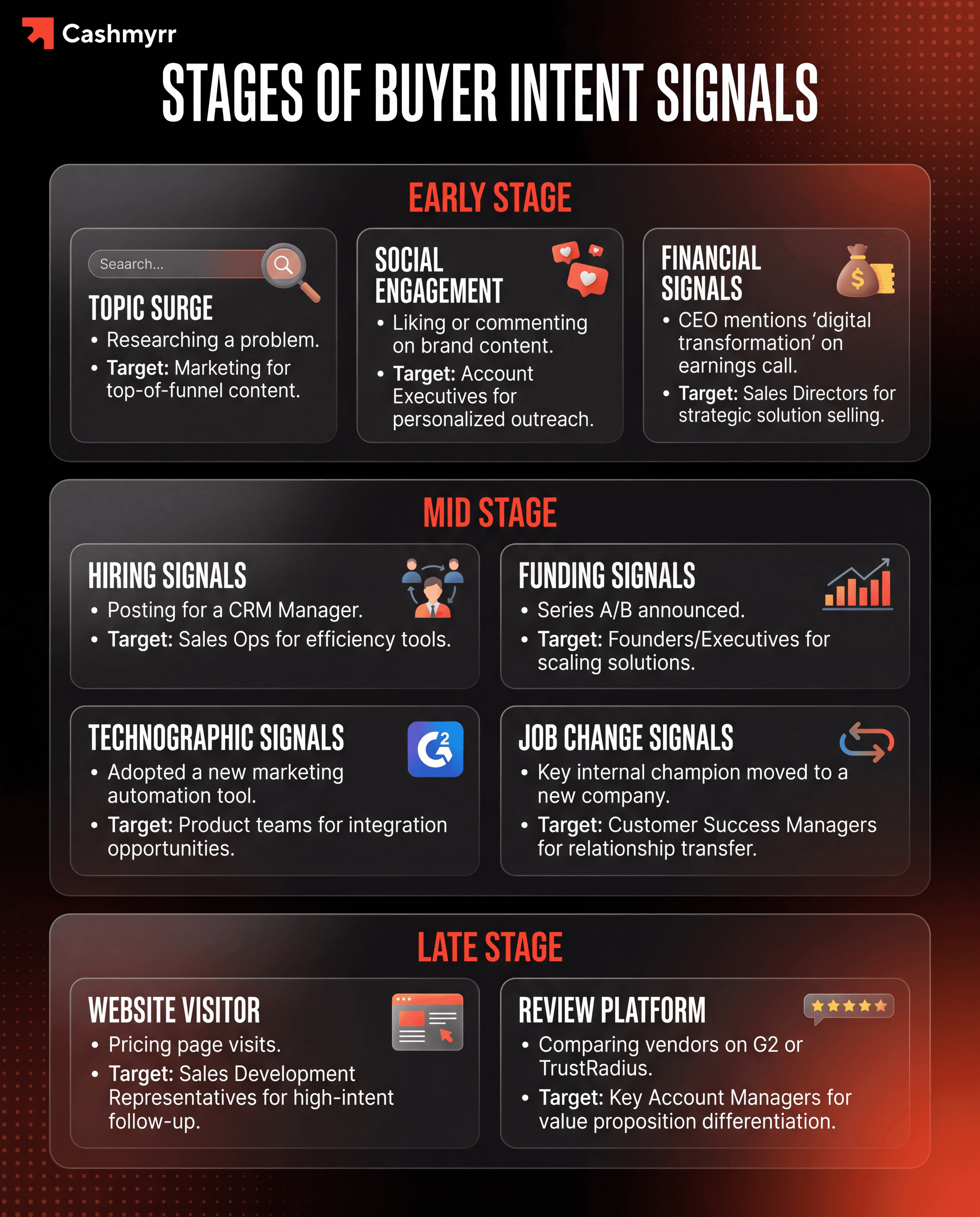
- Website visitor signals reveal which companies are browsing your site via IP-to-company matching. The intent level depends entirely on which pages they visit. Pricing page clusters = high intent. Careers page = irrelevant noise. Filter aggressively.
- Topic surge signals are early-warning indicators. An account is consuming content about "CRM migration" or "sales automation" across external publisher sites at abnormal rates. This means they're in problem-awareness mode, before they've identified specific vendors.
- Review platform signals come from G2, TrustRadius, or Capterra. When a company views your profile, reads reviews, or runs a feature comparison against your competitor, they're deep in evaluation. This is late-stage, high-intent behavior.
- Hiring signals are one of the most underused and highest-value signal types. A company posting for a "CRM Manager," "Head of RevOps," or "Salesforce Admin" is telling you they have a budget, a gap, and a project coming. The role doesn't exist yet, which means there's an immediate window to sell consulting, setup, or implementation services before the hire arrives.
- Funding signals follow a predictable pattern. Post-Series A or B, companies restructure their go-to-market stack within 90 days. Fresh capital means new tools, new hires, and new infrastructure decisions. The window is short but the budgets are real.
- Technographic signals track tool adoption and removal. A company just adopted HubSpot? They'll need implementation help. A company just dropped a competitor? There's an opening for replacement.
- Job change signals track decision-makers moving to new companies. A former champion at one company is now VP Sales somewhere else. They already know your product. This is statistically one of the highest-converting signal types available.
- Social engagement signals measure LinkedIn interactions (likes, comments, shares) with your brand content or leadership posts. Lower intent than website visits, but useful as a "warming" indicator when combined with other signals.
- Financial signals are extracted from earnings calls, investor letters, or public filings. When a CEO mentions "digital transformation" or "operational efficiency" on an earnings call, it creates a strategic hook for enterprise outreach.
The DIY approach: build your own for 10% of the cost
For companies with fewer than 500 employees, enterprise intent platforms are overkill. A combination of low-cost tools and automation can deliver 80% of the value at a fraction of the price.
Two architecture options depending on your team's technical profile:
Option A: n8n + Claude API (fully custom, maximum control)
n8n (open-source workflow automation) acts as the central nervous system.
Signal capture: Google Alerts + RSS feeds from funding news sources (Maddyness, Sifted, TechCrunch) monitor fundraising announcements. Apify or PhantomBuster scrape LinkedIn for hiring signals (e.g., companies posting "CRM Manager" or "RevOps Lead" roles).
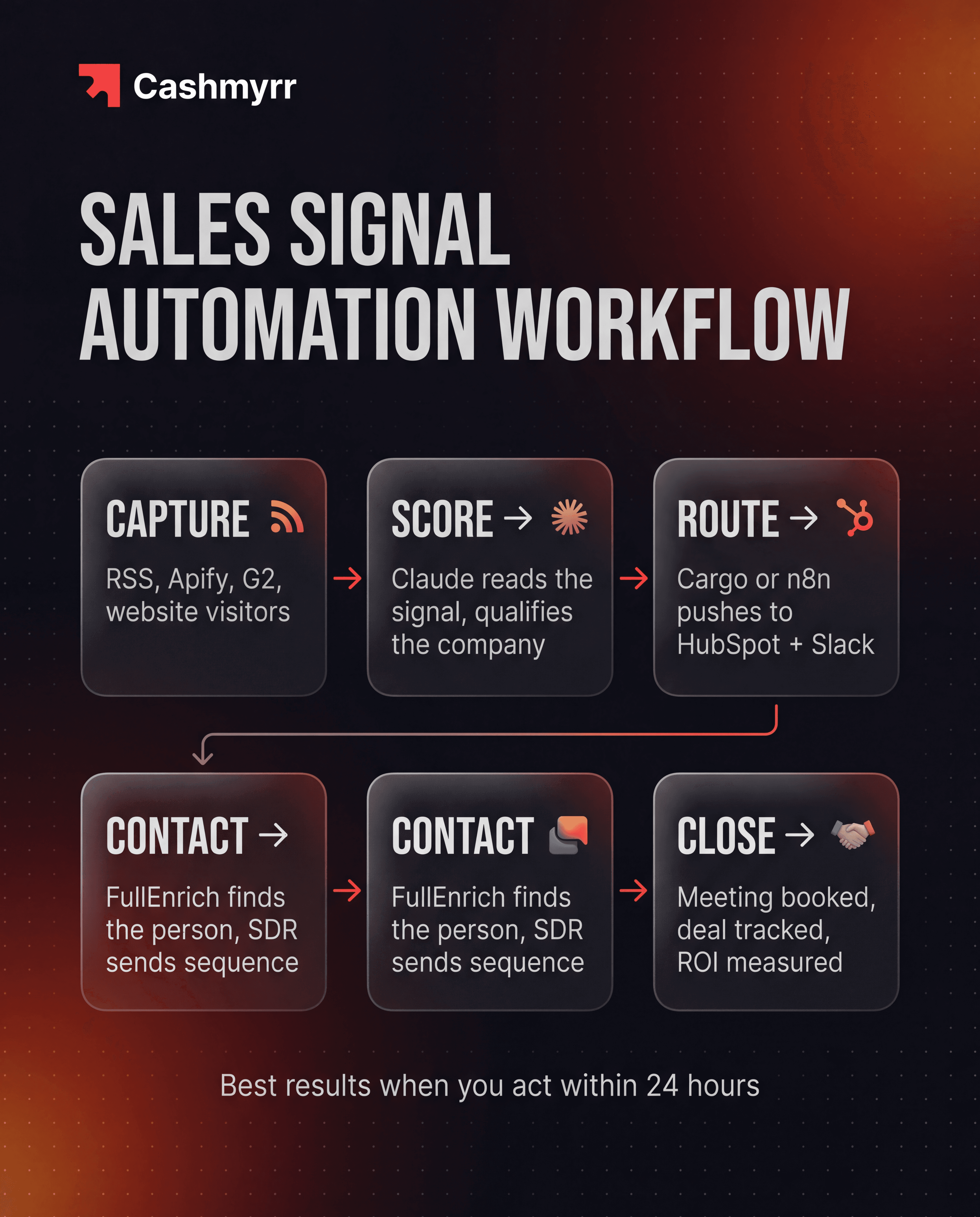
AI parsing with Claude: This is where the intelligence layer lives. Raw signals flow into n8n via webhooks and are routed to the Claude API (Anthropic). Claude reads the unstructured text (a news article, a job description, an RSS item) and does the heavy lifting: extracts the company name and domain, identifies the signal type (funding vs hiring vs tech change), normalizes amounts and roles, scores the lead against your ICP criteria, and drafts a first-touch message tailored to the signal. This isn't basic keyword matching. Claude understands context. It can distinguish between "Company X raised $15M Series A" and "Company X's investor raised a fund" and only pass through the real signal. You define your qualification logic in the system prompt, and Claude applies it consistently to every inbound signal at scale.
CRM activation: n8n calls the HubSpot API to search for existing company records. If none exists, the system creates one. Then it triggers enrichment via FullEnrich or Apollo API to find the right contact. Finally, it creates a Deal in a dedicated Intent Signals pipeline and sends a Slack alert to the assigned SDR with the signal context and Claude's drafted opening pitch.
Option B: Cargo (visual orchestration, faster setup)
Cargo offers the same logic but packaged in a visual workflow builder purpose-built for GTM. Instead of wiring n8n nodes manually, you build the flow in Cargo's interface: signal ingestion from webhooks or CRM triggers, waterfall enrichment across 30+ providers, AI-powered scoring and qualification (Cargo has built-in AI agents that work similarly to Claude API prompts), automatic lead assignment based on territory or round-robin rules, and CRM sync back to HubSpot or Salesforce. Cargo is the better fit if your RevOps team wants to move fast without relying on a developer to maintain n8n workflows.
Total cost for either option: under $1,000/year in tooling. Compare that to $60K+ for an enterprise platform doing roughly the same job with a prettier dashboard.
DIY INTENT PIPELINE
Open-source stack · From raw signal to CRM action
Sources
IdleClaude Parse
AIActivate
CRM● The results
How to integrate intent signals into HubSpot
HubSpot is the CRM most mid-market teams run on. Here's how to make intent data operational inside it.
Use native capabilities first
Breeze Intelligence identifies anonymous website visitors, enriches records with 100+ firmographic attributes, and shortens forms by auto-filling known fields. It works on a credit model and doesn't deplete credits for ongoing 30-day visitor tracking after the initial company addition.
Limitations to know: Breeze doesn't provide direct phone numbers. It doesn't generate net-new emails for unknown contacts. It enriches records that already have an email. For high-volume outbound, you need to pair it with FullEnrich or Cognism.
Build the right data model
Store intent data as custom properties directly on the Company object. Don't use Custom Objects for signals. HubSpot's reporting engine struggles to cross-filter Custom Object data with standard web analytics and pipeline metrics. It creates reporting silos.
Create a property group called "Intent Intelligence" on the Company object with these fields:
- Recent_Intent_Signal_Source (Dropdown): G2, Bombora, Website, RSS, Apify, Manual
- Intent_Signal_Type (Dropdown): Funding, Hiring, Topic Surge, Tech Change, Job Change
- Intent_Signal_Date (Date picker)
- Intent_Topic_Detail (Single-line text): e.g., "Hiring CRM Manager" or "Series B $12M"
- ICP_Fit_Score (Number): calculated upstream in n8n or via workflow
Log each signal occurrence as a Note on the company's activity timeline. This preserves history without overwriting the property values when new signals arrive.
Build a dedicated pipeline
Create an "Intent Signals" pipeline in HubSpot Sales Hub, separate from your commercial pipeline. This keeps lead generation metrics (signal-to-meeting rate) cleanly separated from revenue forecasting (meeting-to-close rate).
Pipeline stages:
- New Signal — Auto-created by workflow when Intent_Signal_Date is updated. Deal is assigned to an SDR via round-robin or territory rules.
- Enrichment & Qualification — SDR receives a Slack notification. They use FullEnrich or Apollo to find the right contact (verified email + phone).
- Contacted — SDR enrolls the contact in a signal-specific sequence (HubSpot sequence or Lemlist campaign). Deal stage moves forward.
- Converted — Meeting booked. Deal marked "Closed-Won" in the Intent Pipeline. An automated workflow creates a new Deal in the commercial Sales Pipeline to track the actual revenue opportunity.
- Disqualified — Signal was noise (wrong ICP, already a client, irrelevant context). Logged and closed.
This bifurcated pipeline approach is how you actually measure whether intent signals generate revenue, not just activity.
How to integrate intent signals into Salesforce
Salesforce's architecture is more rigid but more customizable. The principles are the same; the execution differs.
Native capabilities
Einstein Behavior Scoring (Account Engagement / Pardot Advanced+) uses machine learning to score prospect engagement across marketing assets. Unlike static Pardot scoring, the model continuously adjusts weights based on historical conversion patterns.
Data Cloud is Salesforce's 2026 play for real-time signal ingestion. It federates external data (Snowflake, AWS, BigQuery) directly into the Salesforce UI without ETL duplication. Calculated Insight Objects trigger automated actions based on incoming signals.
Custom implementation
Store signals as custom fields on the Account object: Bombora_Surge_Topics, Last_G2_Visit_Date, Active_Hiring_Roles, Intent_Signal_Source, Intent_Signal_Date. Keeping data on the primary object enables straightforward Reports and Dashboards without complex cross-object joins.
For automation, use Flow Builder with Record-Triggered Flows. Example: when a G2_Intent_Score field is updated via API and exceeds a threshold of 80, the Flow automatically changes Account Status to "Hot," creates a Task assigned to the Account Executive with a 24-hour SLA, and sends a Slack alert with account context.
Be careful with AppExchange packages from enterprise intent vendors. They force predefined custom objects and data models onto your org, which can conflict with existing business logic and inflate subscription costs. For fast-growing teams, custom integrations via Salesforce REST API or MuleSoft offer more flexibility.
How to activate signals (the part most teams skip)
Buying intent data is step one. Activating it is where revenue happens. Most teams fail here because they treat all signals equally and act too slowly.
Sales activation: match the pitch to the signal
Each signal type demands a different persona, a different message, and a different channel.
Hiring signal → Target the budget holder (VP Sales, COO, CEO), not the future hire. "You're hiring a CRM Manager. We can structure the system architecture now so your new hire steps into a clean setup on day one. Most companies lose 3-6 months waiting for the person to arrive and then figure it out."
Funding signal → Target C-level or Head of Ops. "Post-Series B, most companies restructure their CRM and go-to-market stack within 90 days. We help you build the infrastructure before the scaling pain hits."
G2 review signal → Target the evaluation committee lead. "Comparing CRM solutions is time-consuming. We've helped 40+ companies navigate the exact evaluation you're running. Want a framework?"
Job change signal → Target the former champion at their new company. "Congrats on the move. Want to replicate the RevOps system that worked at your last company?"
Tech adoption signal → Target the operations lead. "You recently adopted HubSpot. Here are the 5 implementation mistakes that cost teams 3 months of rework."
Enforce SLAs with automation
Speed is the single biggest differentiator. Build this into the CRM:
If an SDR doesn't log a call or email against a signal account within 24 hours, the workflow escalates to a manager or reassigns to a secondary rep. No exceptions. Intent signals decay in 7 to 14 days. A 48-hour response window is already late for the highest-converting signal types.
Track what actually converts
Not all signal types perform equally. Build a feedback loop:
If "Topic Surge" signals convert to meetings at 1% but "Job Change" signals convert at 12%, reallocate SDR focus and marketing budget toward job change signals. If hiring signals in your ICP consistently generate 3x more pipeline than funding signals, double down.
Measure: signal volume by type, signal-to-meeting rate, signal-to-pipeline rate, signal-to-revenue attribution. These are the numbers that tell you whether your intent investment is working or just generating dashboards.
What goes wrong (and how to avoid it)
False positives kill SDR trust
Third-party topic surges are noisy. A "surge" can be triggered by a student writing a paper, a competitor doing competitive intel, or an employee upskilling. If SDRs get burned by 10 bad signals in a row, they stop trusting the system entirely. Always cross-reference third-party surges with first-party web visits or high ICP fit scores before routing to sales.
Signal decay is real
Intent data expires in 7 to 14 days. If your operational infrastructure takes a week to route, enrich, and assign a signal, you've already lost most of its value. The entire point of building automated workflows is to compress this window to hours, not days.
Account-level intent without contact-level data is useless
Most providers deliver "Company X is researching CRM software." They don't tell you which person at Company X is the buyer. If you buy intent data without pairing it with a contact enrichment layer (FullEnrich, Apollo, Cognism), your SDRs are left guessing who to call. That's not a data problem. It's an architecture problem.
Expensive platforms without operational infrastructure
Companies buy $60K intent platforms assuming the software will generate pipeline by itself. It won't. Without clean CRM data, automated routing workflows, enforced SLAs, and signal-specific sequences, the data just clutters the database and breeds executive frustration.
The fix is always the same: build the operational layer first (properties, pipeline, workflows, sequences), then layer on the data sources. Not the other way around.
GDPR compliance is non-negotiable for EU targeting
If you target buyers in the EU, using non-compliant scrapers or gray-market contact databases creates legal exposure. Dealfront and Cognism exist specifically for this reason: DPA-compliant infrastructure, human-verified data, and IP-matching that avoids unauthorized scraping.
What "good" looks like after implementation
After implementing intent signals properly, your CRM becomes a live radar system, not a static database.
- Your SDRs wake up to a prioritized list of accounts showing buying behavior right now, with the right contact already enriched and a signal-specific pitch angle pre-loaded.
- Your pipeline reports show exactly which signal types generate the most meetings, the most pipeline, and the most revenue, so you can double down on what works and cut what doesn't.
- Your marketing team builds audiences from intent data instead of guessing, running ABM campaigns against accounts that are actually in-market rather than spraying ads at static lists.
The whole system runs on automation. Signals are captured, parsed by Claude, scored, routed through Cargo or n8n, and tracked without anyone manually copy-pasting between tabs.
That's the shift: from "we have data" to "we have an engine."
● The tips
What's changing in 2025-2026
AI signal synthesis. The market is moving from "alert me when one thing happens" to "combine five weak signals into one strong buying prediction." Platforms like Cargo, Clay, Default, and Common Room use AI to synthesize a LinkedIn like + a pricing page visit + a recent Series B into a single high-confidence score. Cargo stands out here as a true revenue orchestration layer: it connects to 50+ data providers, lets you build visual workflows that enrich, score, assign, and route leads in real time, and deploys AI agents that research accounts and take action autonomously, all synced back to your CRM. Think of it as n8n with a native GTM brain.
Agentic AI in sales. AI agents now execute entire workflows without manual intervention. Claude (Anthropic) is particularly effective in this stack: it parses unstructured signals (news articles, job postings, earnings transcripts), extracts structured data (company name, funding amount, role title), scores leads against custom ICP rubrics, and drafts personalized outreach, all via API inside an orchestration tool like Cargo or n8n. The human reviews and sends. The machine handles research, qualification, and preparation.
Contact-level intent. The market is pushing hard away from account-level guessing ("someone at Microsoft is researching CRM") toward knowing exactly which individual is doing the research. TechTarget and advanced deanonymization tools are leading this shift.
Cookie deprecation. Third-party cookies are dying across Safari, Firefox, and increasingly Chrome. This degrades traditional bidstream intent data quality. Organizations are investing in first-party tracking, server-side infrastructure, and consent-based deanonymization to compensate.
The convergence play. Enrichment, intent, and outreach are merging into single platforms. Cargo, Clay, Apollo, and Common Room each represent a version of this convergence. The days of buying 6 separate tools to cover the signal-to-outreach pipeline are numbered. Cargo in particular is pushing this hard with its all-in-one orchestration approach: signal capture, enrichment, AI scoring, routing, and CRM sync in a single visual workflow.