Lead Generation
You don't have a lead gen problem. You have a system problem.
In the Audit, Data-Cleaning, Enrichment, and TAM steps, you built a CRM that's clean, structured, scored, and tiered. Lead generation is where you activate that foundation, where you contact the right buyers across multiple touchpoints in a coordinated way that feels natural, not pushy.
Most companies start lead gen backwards: they buy a list, blast cold emails, and hope for replies. That's not lead generation. That's spam with a CRM license.
Real lead generation is a system, a repeatable process that combines inbound attraction and outbound activation, orchestrated through the CRM so every touch is tracked, attributed, and actionable.
What you should get at the end (the deliverables):
an Outbound Engine (sourcing → enrichment → multichannel sequences → CRM sync → response handling)
an Inbound Capture System (forms, content offers, website tracking, attribution, and lead routing)
a Channel Orchestration Plan (which channels, in what sequence, for which tier)
a Performance Dashboard (reply rates, meeting booked rates, cost per lead, pipeline generated)
If those aren't clearly produced, you're running campaigns, not building a lead gen system.
Why Lead Gen comes after TAM, enrichment, and scoring (not before)
Most teams want to start "doing lead gen" immediately. But if you skip the earlier steps of the CRM optimization cycle, your lead gen will suffer from predictable problems:
Without audit + cleaning: you'll contact outdated records, reach people who left the company 2 years ago, and send emails to bouncing addresses. Your domain reputation takes the hit.
Without enrichment: your records lack the context needed to personalize at scale, no LinkedIn URL, no verified email, no seniority level.
Without TAM + scoring: every account looks the same. SDRs waste time on Tier 3 companies when Tier 1 accounts sit untouched.
Lead gen built on a clean, enriched, and scored CRM base compounds value. Lead gen built on a messy database compounds waste.
The sequence matters: Audit → Clean → Enrich → TAM → Score → Lead Gen.
THE STAGES
Outbound lead generation: the engine
The outbound funnel in numbers
Before you build, know the benchmarks. These help you size the effort realistically.
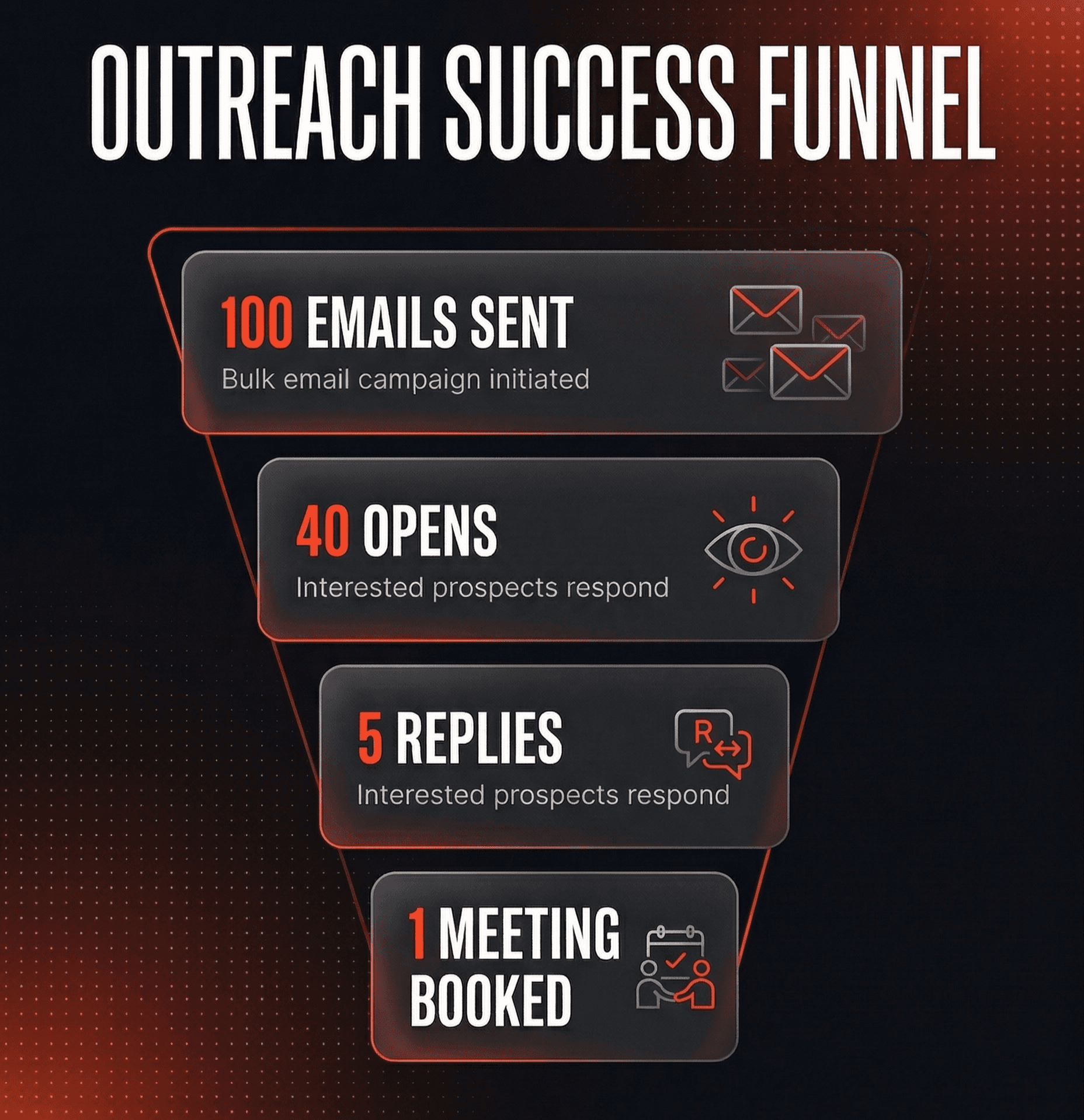
A typical B2B cold email funnel looks roughly like this: out of 100 emails sent, approximately 40 will be opened, 3 to 5 will get a reply, and about 1 will convert into a booked meeting. (LevelUp Leads, 2025)
The average B2B cold email reply rate in 2025–2026 sits between 3% and 5%, depending on targeting precision and personalization. Top performers reach 10–15%+ on well-segmented campaigns.
On LinkedIn, the numbers shift: average response rates are around 10.3% , roughly double that of cold email. Personalized connection requests achieve a 9.4% reply rate versus 5.4% without a message.
What this means in practice: outbound is a volume game with a quality filter. You need enough volume to generate pipeline, but every record you contact must be worth the touch. That's why TAM, scoring, and enrichment come first.
A) Sourcing: who to contact (and who NOT to)
Outbound starts with a targeting decision, not a tool decision.
Use your scoring model to decide which accounts enter outbound:
Tier 1 accounts (high account score + active intent signals) → structured outbound/ABM sequences with a more personalized, account-centric approach
High intent score (regardless of tier) → prioritize separately and push into sequences, since the buying signal is already warm
Tier 2 → batch prospection cadences, less personalized
Tier 3 → one-shot, lighter-touch or nurturing only
Map the buying committee, not just "a contact":
The pattern we repeat across engagements: 3 to 5 contacts per target company, mapped to specific roles that match your sales playbook. Not "everyone at the company", the personas that actually show up in your deal cycle.
B2B buying committees now average 6–10 stakeholders per deal, and reaching multiple contacts at the same company can increase response rates by up to 93% compared to single-contact outreach.
B) Multichannel sequences: email + LinkedIn + phone
Relying on a single channel is the most common outbound mistake. Campaigns using three or more channels can achieve up to **287% higher engagement** compared to single-channel strategies.
Here's how the channels typically perform and complement each other:
Email remains the backbone: highest volume, easiest to automate, and still one of the best ROI channels, roughly $36 returned for every $1 spent according to Litmus. But cold email alone has a reply rate ceiling of 3-5% for most teams.
LinkedIn is the force multiplier: it offers a professional context where prospects are already in work mode. Reps who master social selling create **45% more opportunities** and are 51% more likely to hit quota.
Phone is the closer: cold calling is making a comeback as part of multichannel. Roughly **82% of buyers will agree to a meeting from a cold call** when the outreach is relevant and well-timed.
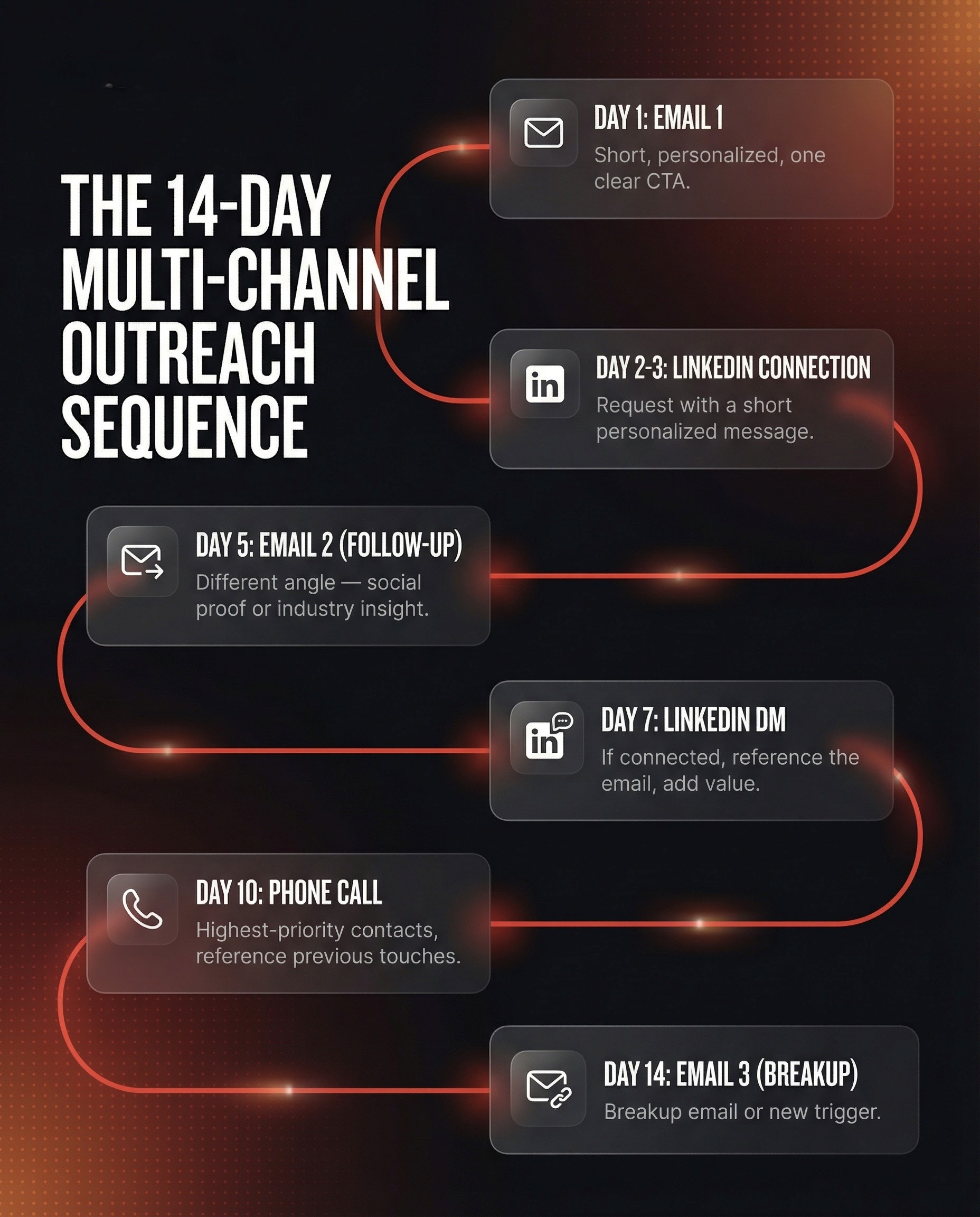
The sequence logic we typically implement:
Day 1: Email 1 (short, personalized, one clear CTA)
Day 2–3: LinkedIn connection request with a short personalized message
Day 5: Email 2 (follow-up, different angle — social proof or industry insight)
Day 7: LinkedIn DM if connected (reference the email, add value)
Day 10: Phone call to highest-priority contacts (reference previous touches)
Day 14: Email 3 (breakup email or new trigger)
This isn't a template to copy blindly. The exact cadence depends on your ICP, your deal cycle, and your SDR capacity. But the principle is universal: multiple touches, multiple channels, consistent value proposition, escalating personalization.
C) Personalization at scale (without writing every email by hand)
The era of "Hi {first_name}, I noticed your company {company_name}…" is over. That's not personalization. That's a merge field.
Real personalization means demonstrating you understand the prospect's specific situation: their industry challenges, recent company news, role-specific pain points, or competitive context.
Personalized emails are opened **82% more** than generic bulk-sends, and personalized CTAs convert 200%+ better than generic ones.
How to personalize at scale:
Use enrichment data: the industry, headcount, tech stack, and seniority you collected in the enrichment step become personalization variables.
Use AI for research synthesis: tools like an LLM can analyze a prospect's LinkedIn profile, recent company news, and job history to generate a personalized opening line then a human reviews and adjusts.
Segment by persona and pain point, not just by company size. A CFO and a VP Sales at the same company need different messages.
Keep emails short: the sweet spot is 50-125 words, which achieves roughly **50% higher reply rates** than longer formats.
D) Deliverability: the invisible make-or-break
None of this matters if your emails land in spam.
Since February 2024, Google and Yahoo require all bulk senders to have SPF, DKIM, and DMARC authentication in place. Microsoft followed in May 2025. Gmail's enforced spam complaint threshold is **0.1%,**exceeding it risks filtering or permanent rejection.
Practical deliverability rules:
Authenticate your sending domain (SPF + DKIM + DMARC). This is table stakes, not optional.
Warm up new domains progressively before running campaigns at scale.
Keep bounce rates below 2% — this is why enrichment with verified emails matters.
Monitor spam complaints and keep them far below 0.3%.
Use a dedicated subdomain for outbound (e.g.,
outreach.yourdomain.com) to protect your primary domain reputation.Separate your outbound sending from your marketing email infrastructure.
Improving deliverability can increase lead volume by 50% and reduce marketing costs by 33%.
Inbound lead generation: the magnet
Outbound gives you speed and control. Inbound gives you efficiency and compounding returns. You need both.
The case for inbound
Inbound leads cost significantly less: on average, **62% less per lead** than outbound. And they convert at a higher rate, SEO-generated inbound leads close at approximately 14.6%, compared to roughly 1.7% for outbound.
But inbound takes time to build. It doesn't produce pipeline in week one the way outbound can. That's why the two motions must work in parallel.
A) Website tracking + form capture (the "data tap")
Your website is already generating intent signals. The question is whether your CRM captures them.
What to set up:
CRM tracking script (e.g., HubSpot tracking code): links anonymous web visits to known CRM contacts via the tracking cookie. But, as we discovered in our audit work, this script must only fire after explicit cookie consent (GDPR/CookieFirst), or you risk polluting your base with non-consented contacts.
Smart forms: capture only what you need (email + one qualifying field). Every additional field you add reduces conversion. A common improvement: reducing form fields from 7 to 4 can lift submissions by 10-20%.
Content gating strategy: not every piece of content needs a form. Gate your highest-value assets (calculators, benchmarks, templates). Keep educational blog posts open for SEO.
Critical: close the "data tap" leaks.
One of the most common audit findings is that custom forms, search bars, or third-party integrations are sending data to the CRM and creating thousands of empty or non-consented contacts. Lock this down by:
disabling CRM features that allow contact creation from non-CRM forms,
making tracking conditional on cookie consent,
setting up automatic segmentation workflows for new contacts (B2B vs B2C, source-based tagging).
B) Content as a lead gen engine
Content marketing isn't a "nice to have" alongside outbound. It's the pre-sell that makes outbound work better.
In a hybrid model, inbound content serves as credibility infrastructure. When an SDR reaches out (outbound), the prospect might say: "Oh, I've seen your articles on LinkedIn." This drastically increases the chance of a "yes."
What works in B2B content for lead gen:
Educational articles that address a specific ICP pain point (like this series)
Webinars and live sessions with Q&A (registration = lead capture)
Case studies and industry benchmarks (gated behind a simple form)
Templates and tools (calculators, audit checklists, scoring templates)
The key: content must be useful enough that someone would share it with a colleague. If it reads like a product brochure, it won't generate trust.
C) SEO: the long game with the highest ROI
SEO campaigns achieve an average cost per lead of approximately $47, compared to $70+ for PPC.
The compounding effect is what makes SEO unique: a well-ranking article generates leads for months or years after publication. Paid ads stop the moment you stop paying.
For B2B companies, the highest-value SEO strategy targets problem-aware keywords (e.g., "how to clean CRM data", "CRM audit checklist", "B2B lead scoring best practices") rather than brand or product keywords. These attract prospects who are already researching a solution, they just haven't chosen a vendor yet.
The CRM as the orchestration layer
Everything flows through the CRM (or it doesn't count)
The biggest lead gen mistake isn't choosing the wrong tool or the wrong channel. It's running lead gen outside the CRM.
When outreach happens in a tool that doesn't sync back, you lose:
attribution (where did this meeting come from?),
history (what did we already say to this person?),
routing (who should follow up?),
reporting (what's actually working?).
Every touch, outbound email, LinkedIn message, phone call, form submission, content download, must create or update a CRM record.
Lead lifecycle in the CRM
A clean lead lifecycle prevents the most common problem: confusion about what's "a lead" versus "an opportunity."
A practical model:
New Lead → initial capture, basic research
Contacted → outreach has started (sequence enrolled)
Engaged → prospect responded positively
Qualified → meets criteria for handoff to sales (becomes Contact + Deal)
Disqualified → not a fit, archived with reason
Exit criteria must be explicit at each stage. If they're not, two reps will classify the same interaction differently, and your dashboard becomes politics, not truth.
Automation: what to automate (and what NOT to)
Automate:
Lead assignment (round robin or territory-based) when an enriched, scored account meets Tier 1 criteria
Sequence enrollment for new qualified accounts (batch cadence, e.g., 15–20 per SDR per week)
Response detection + CRM status update + owner notification (Slack/email)
Follow-up task creation if no meeting is booked within X days (e.g., J+2 after lead creation → add high-priority task)
Lifecycle stage progression based on clear trigger events
Do NOT automate:
The personalization layer of outreach (AI can draft, but a human must review)
Qualification decisions (a rep, not a workflow, decides if a lead is truly qualified)
Merge/dedup decisions on ambiguous records (keep the AI-assisted merge workflow from Data Cleaning, with human review)
Inbound + outbound synergy: the hybrid model
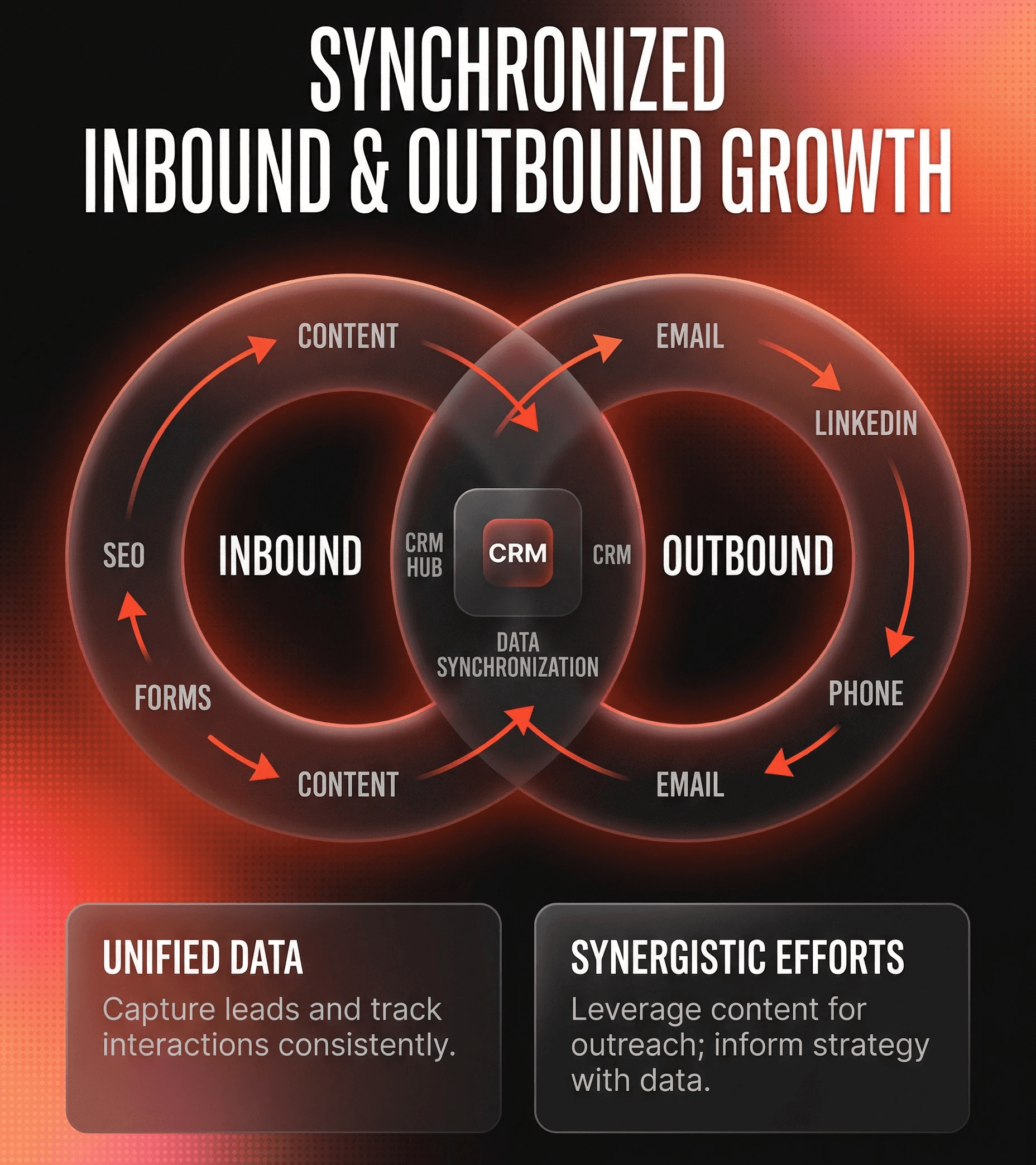
The most effective lead gen systems in 2025 don't choose between inbound and outbound. They build a flywheel where each motion feeds the other.
Inbound signals fuel outbound timing:
If your CRM shows that a specific company has visited your pricing page three times this week (inbound signal), that's the perfect moment for an SDR to send a personalized email (outbound action). This is where intent signals (covered in the next article of this series) and lead scoring multiply outbound effectiveness.
Outbound warms up inbound:
SDRs sharing content on LinkedIn, sending case studies in sequences, and referencing blog posts in cold emails all create "brand familiarity" that makes future inbound easier. The prospect remembers the name when they search later.
Nurture bridges the gap:
Not every lead is ready to buy now. Leads that are qualified on paper but not ready to engage should enter a nurture track, marketing emails, LinkedIn content, invitations to webinars, that keeps the relationship warm without wasting SDR time. (Nurturing is its own step in this series.)
Companies using at least three lead generation channels realize approximately **19% higher engagement rates** and a 9.5% annual revenue boost compared to single-channel approaches.
The orchestration stack (tools)
There is no single "lead gen tool." Lead gen is a workflow that crosses multiple tools, orchestrated through the CRM. Here's a practical stack we use:
CRM (the core): HubSpot or Salesforce, depending on the client. This is where every record lives, every lifecycle stage is tracked, and every dashboard pulls from.
Orchestration / automation: n8n or Cargo for building repeatable workflows: sourcing → enrichment → scoring → dedup → CRM import → sequence enrollment → response handling. These are the "workers" that make lead gen scalable without manual CSV imports.
Enrichment: LinkedIn Sales Navigator (for sourcing + freshest company/contact data) + FullEnrich (cascading enrichment for emails/phones across multiple providers) + Enrow (email validation and deliverability checks).
Outreach: Dedicated outreach platforms for email sequencing (separate from marketing email) + LinkedIn automation. The separation is critical: your marketing email reputation must not be affected by cold outbound bounce rates.
Scoring: CRM-native scoring (HubSpot/Salesforce) + AI-enhanced scoring (e.g., GPT-based lead scoring that analyzes full contact context to prioritize the most relevant leads).
Reporting: CRM dashboards + data warehouse (for cross-tool analysis: attribution, cost per lead, channel comparison, pipeline velocity).
The stack changes per client. The principle doesn't: every tool must write back to the CRM, or it's a silo.
Measuring what matters
The metrics hierarchy
Not all lead gen metrics are equal. Here's a practical hierarchy:
Outcome metrics (what leadership cares about):
Pipeline generated (€ value of opportunities created from lead gen)
Meetings booked (the primary conversion event)
Cost per meeting/cost per opportunity
Lead-to-close rate
Leading indicators (what ops tracks weekly):
Reply rate (email + LinkedIn) → benchmark: 5–10% is solid, 10%+ is excellent
Positive reply rate → subset of replies that express genuine interest
Sequence completion rate → are SDRs actually finishing cadences?
Bounce rate → should stay under 2%
Spam complaint rate → must stay under 0.1%
Diagnostic metrics (when something breaks):
Open rate → useful as a deliverability diagnostic, not as a goal (Apple Mail Privacy Protection inflates tracking data)
Unsubscribe rate → spikes after follow-up 2 suggest message fatigue
Data freshness → last enrichment date vs today
The weekly review rhythm
A practical cadence:
Monday: review new enriched accounts, plan week's prospection, enroll new batch
Wednesday: mid-week pipeline check, update lead statuses, flag stalled sequences
Friday: week closure, performance review (reply rates, meetings booked), next steps planning
What "good" looks like after implementing lead gen
After a well-structured lead gen system:
SDRs receive pre-qualified, pre-enriched accounts weekly, with enough context to personalize outreach on day one.
Outbound runs across email + LinkedIn + phone in a coordinated sequence, not as disconnected one-off blasts.
Inbound captures website visitors and content engagement as CRM records with attribution, feeding both scoring and sales follow-up.
Every response is detected, logged in the CRM, and routed to the right owner with a notification.
Dashboards show real pipeline impact, not vanity metrics. You can trace a meeting back to its source channel and its original scoring tier.
The system runs weekly with minimal manual input: new accounts flow in, sequences fire, responses route, and the ops team monitors performance.
You're not "sending cold emails." You're building a machine that converts enriched, scored, and well-timed outreach into predictable pipeline.